Overview
There are two kinds of jobs in Jobber, one-off jobs and recurring jobs. One-off jobs let you schedule, manage, and bill for work that does not repeat — from a single visit to a multi-day project.
Use a one-off job for:
- Work with a single visit
- Work with multiple visits across different days, weeks, or non-consecutive dates, where you invoice at the end
One-off jobs support up to 20 visits in a single flow. For work that repeats on a regular schedule, create a recurring job instead.
One-off jobs can also be created in the Jobber mobile app. Learn more about Jobs in the Jobber App.
How to create a one-off job
You can create a job from many places on Jobber.com, including:
- the Create button from the side navigation
- the More button on schedule
- the Create button on a client’s profile
- the Convert to Job button on an approved quote
- On requests, select the More button, then select Convert to job
Select a client and add job details
When creating a new job, start by filling in the job title in the Title field. This typically the name of the type of work you’ll be doing. This will be visible as the name of your job on on your schedule in Jobber.com as well as on the Jobber mobile app. The job title will not show to the client and is often used as a description of the job that you will be doing.
Next, select a client. Start typing in the Select a client field and choose from the list. Select Create New Client if they are not yet in your account. When you convert a request or quote to a job, Jobber fills in the client automatically.
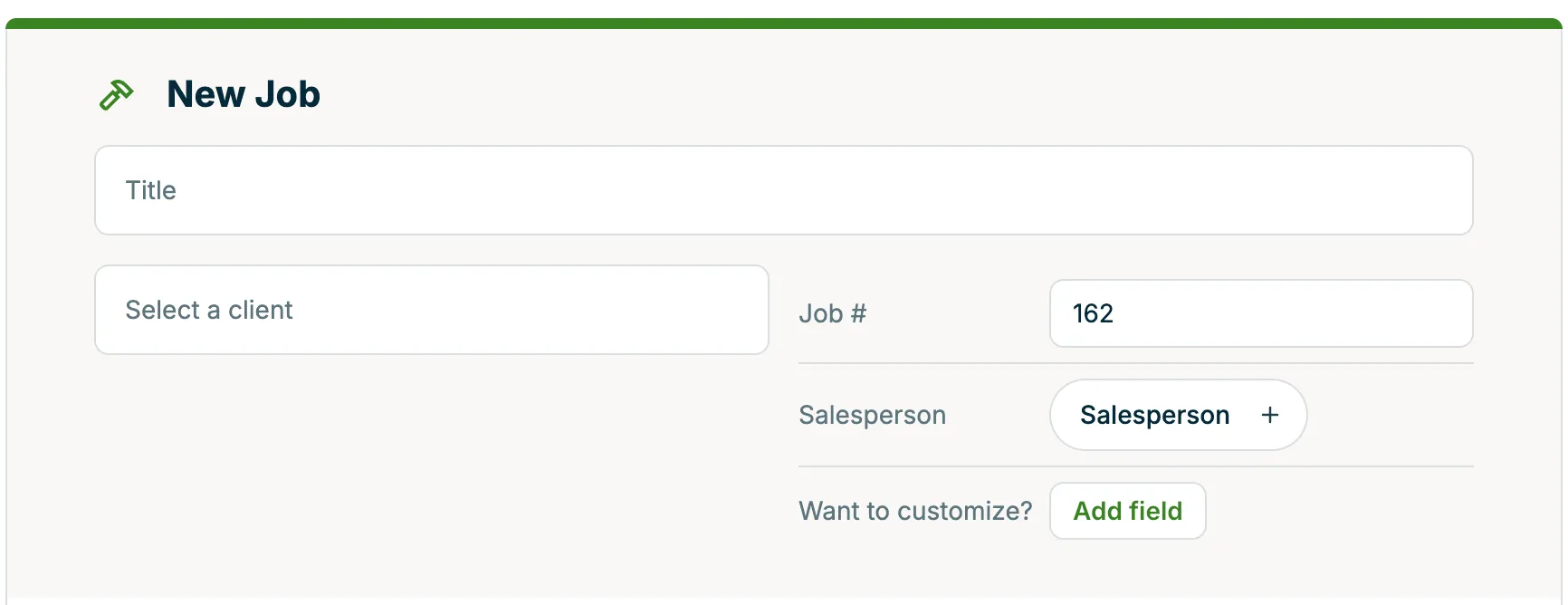
On the right of the job title and client name are the job details. This includes the job number and salesperson. To change the job number, click Change then enter a new job number. Job numbers count upwards from the highest job number currently in your account. If your current highest job number is #123, the next job you make will default to #124.
If you have any job level custom fields set up, they can be filled out while creating the job. To add a new custom field (that will appear as a field on all job), select the Add field button.
Set up your visit schedule
Next, is setting up the schedule for this job. At the top of the schedule section, you’ll see a quick reference showing how many visits will be created for this one-off job.
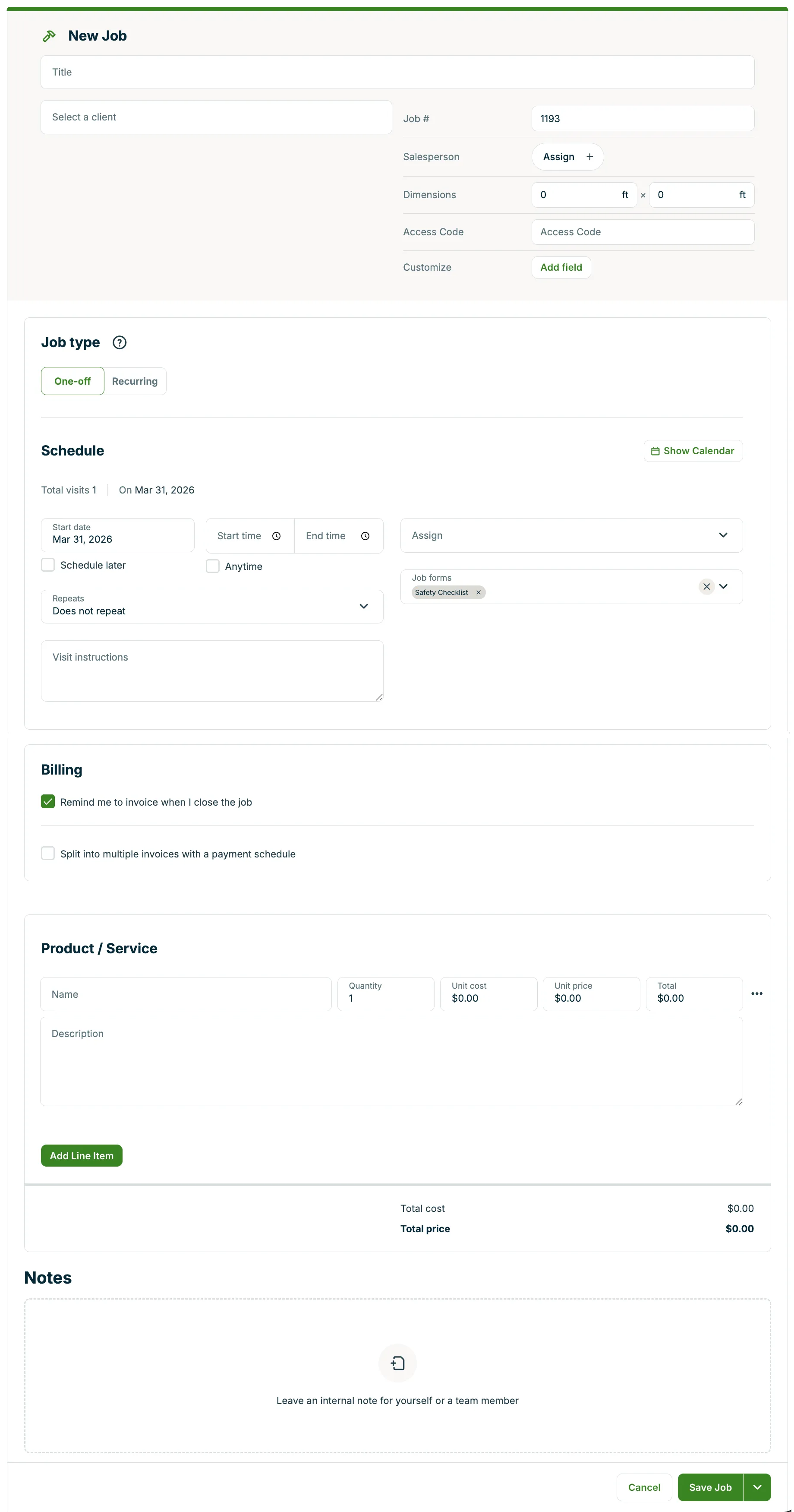
To create a one-off job, make sure to select the One-Off Job tab from under Schedule.

To the right of the schedule selector, you will see how many visits you’re creating as part of this job. This will update as you fill out the job details.
Schedule a single visit
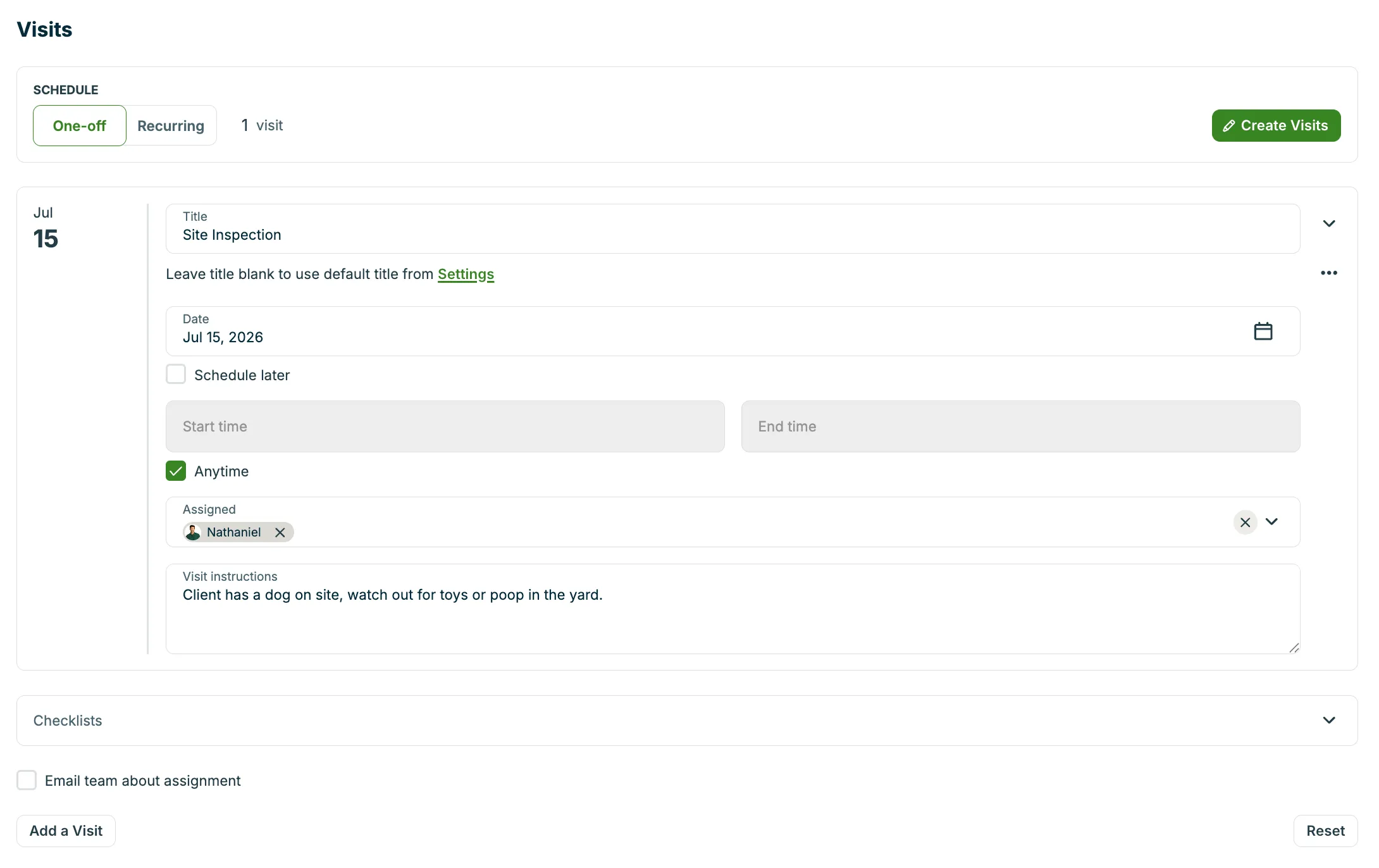
To create a one-off job with one visit:
- Select the One-off job tab from the schedule selector.
- Select a Start Date. If you are not ready to set a date yet, select Schedule later This creates a job in unscheduled status with a placeholder visit you can schedule later.
- Select start and end times for the visit. If you leave the time blank, the visit becomes an anytime visit — it has a date but no specific time on that day.
- Use the Assign dropdown to add team members who will be completing this work. If no one is assigned, the visit stays unassigned and can be assigned later.
- Enter any team instructions in the Visit Instructions field. Instructions are internal — your client does not see them — and carry forward to all visits on this job. To change instructions for a specific visit, edit that visit from the schedule.
- Use the Checklists dropdown to add checklists to this job. Checklists added at the job level apply to all visits. Learn more about checklists.
Schedule multiple visits
There are two ways to set up your schedule to include multiple visits:
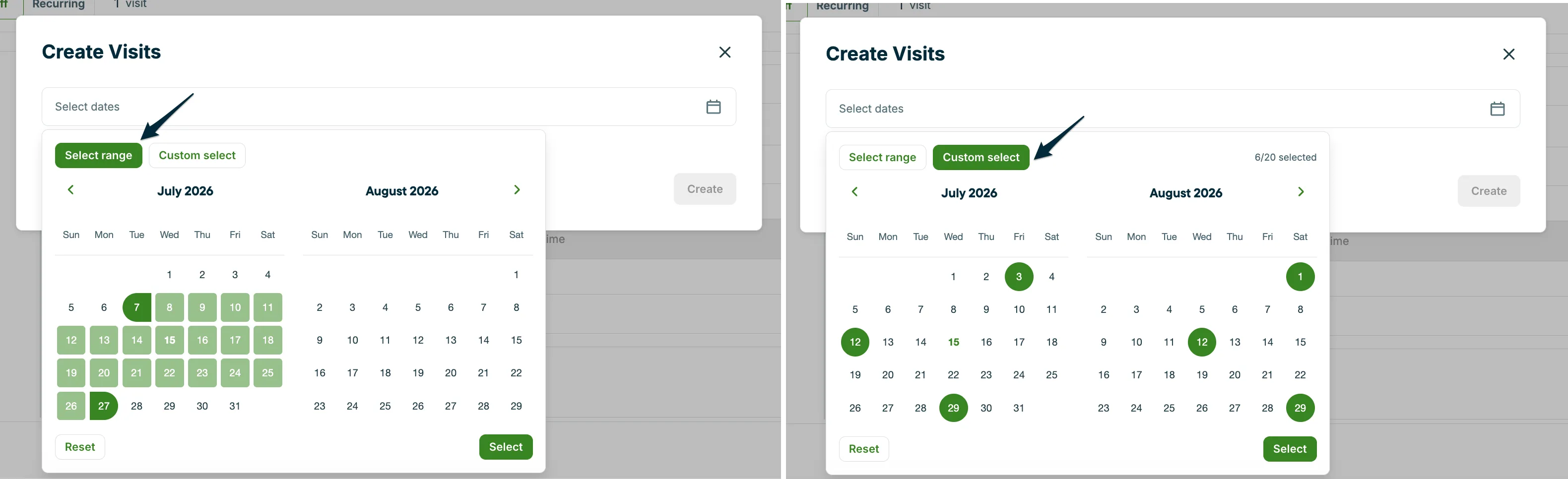
- Date range: select a continuous range of dates. Jobber creates a visit for each day in the range.
- Individual dates: pick specific dates with gaps in between — useful for jobs that happen on particular days but not every day.
To schedule a one-off jobs with multiple visits:
- Select the One-off job tab from the schedule selector.
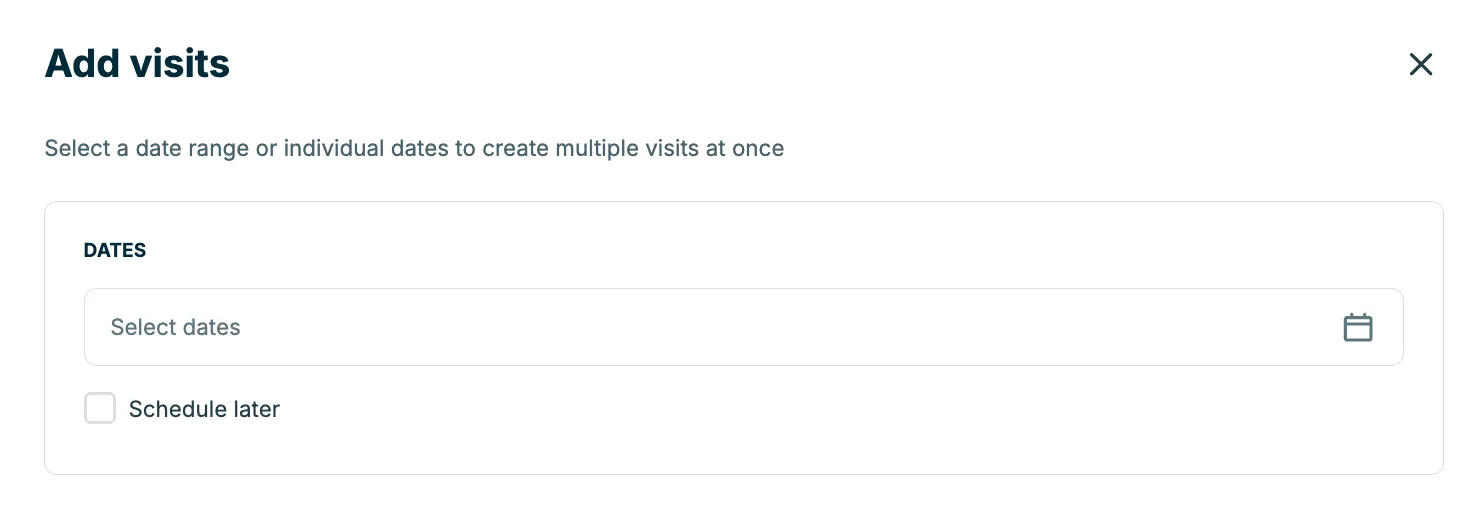
- Click the Create Visits button, then select your visit dates. From the date picker, choose between the options for Select range to select a continuous range of dates, or Custom select to schedule visits on particular days.
- Once your dates are selected, click Create to schedule the visits.
- Now that your visits are created, click each visit to expand the details. Each of these visits can be edited to add the start time, assigned team, and visit instructions. You can apply the same details to all visits at once, or customize each visit individually.
Note: If arrival windows are set up in your work settings, the Arrival windows field appears once you enter a start time. Learn more about arrival windows.
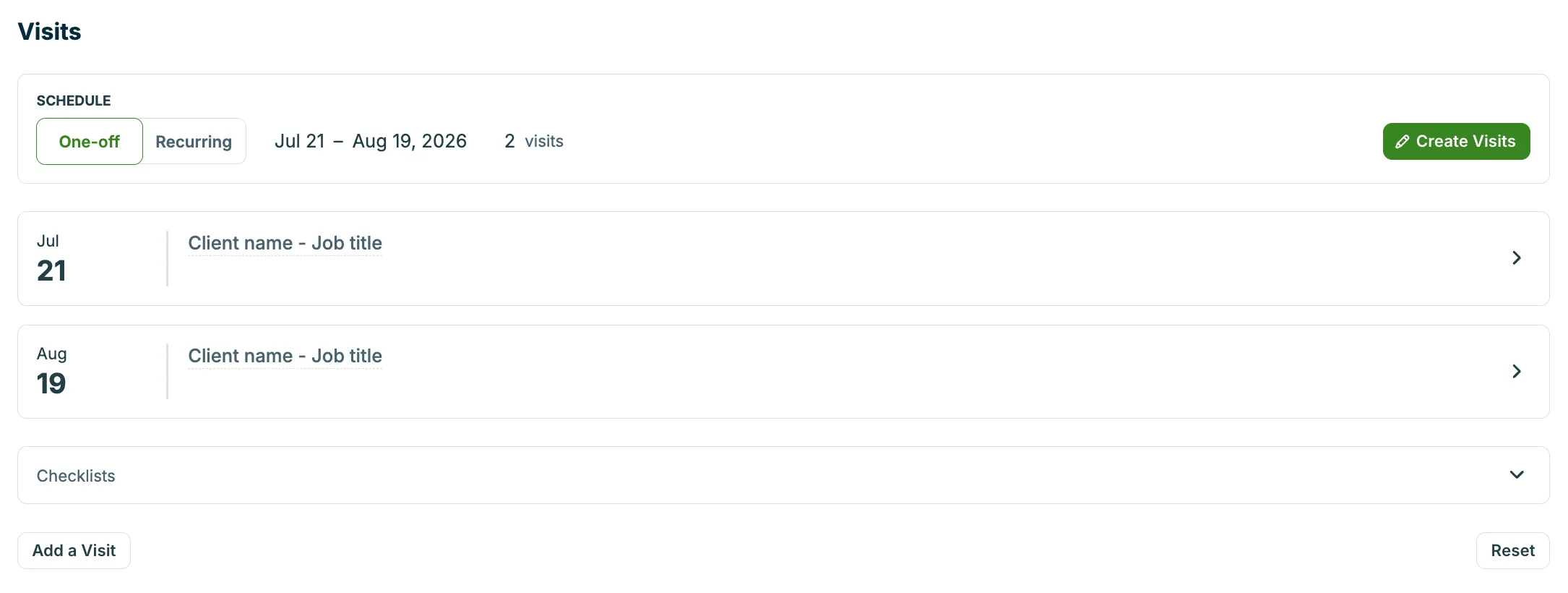
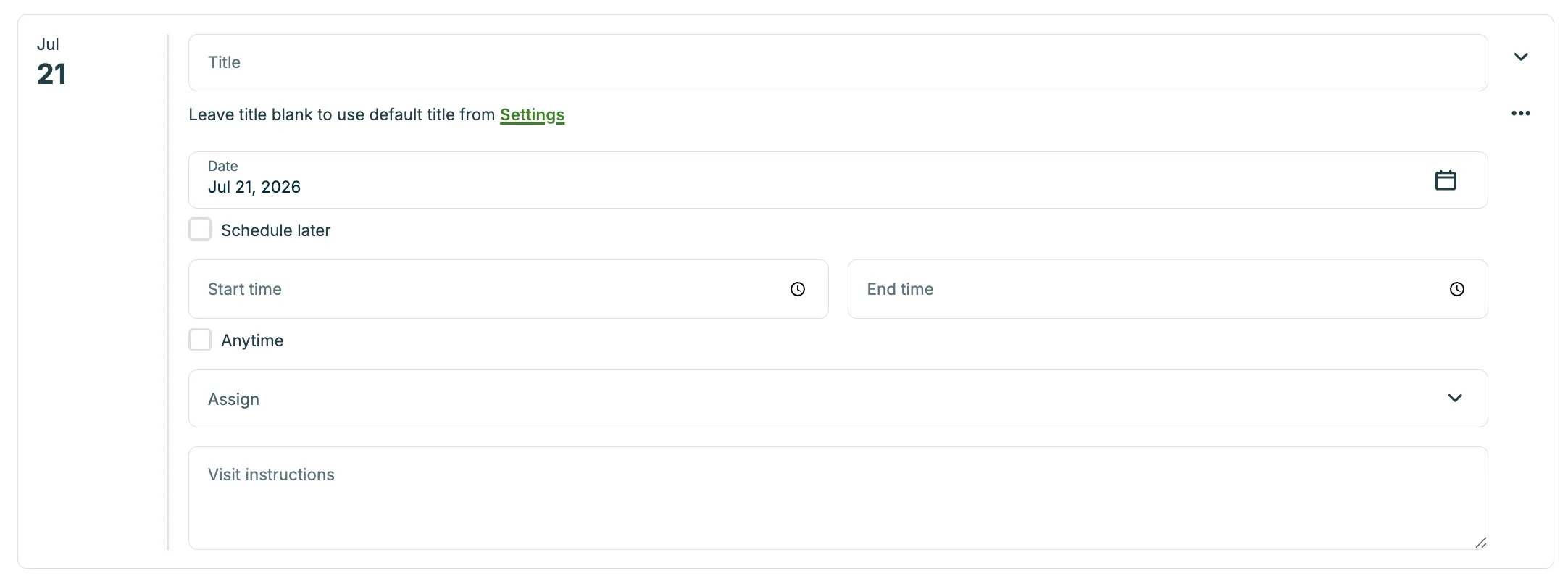
Each visit is scheduled for the date you select. To add more visits during job creation, select Add visit at the bottom of the visits section of the job creating screen.
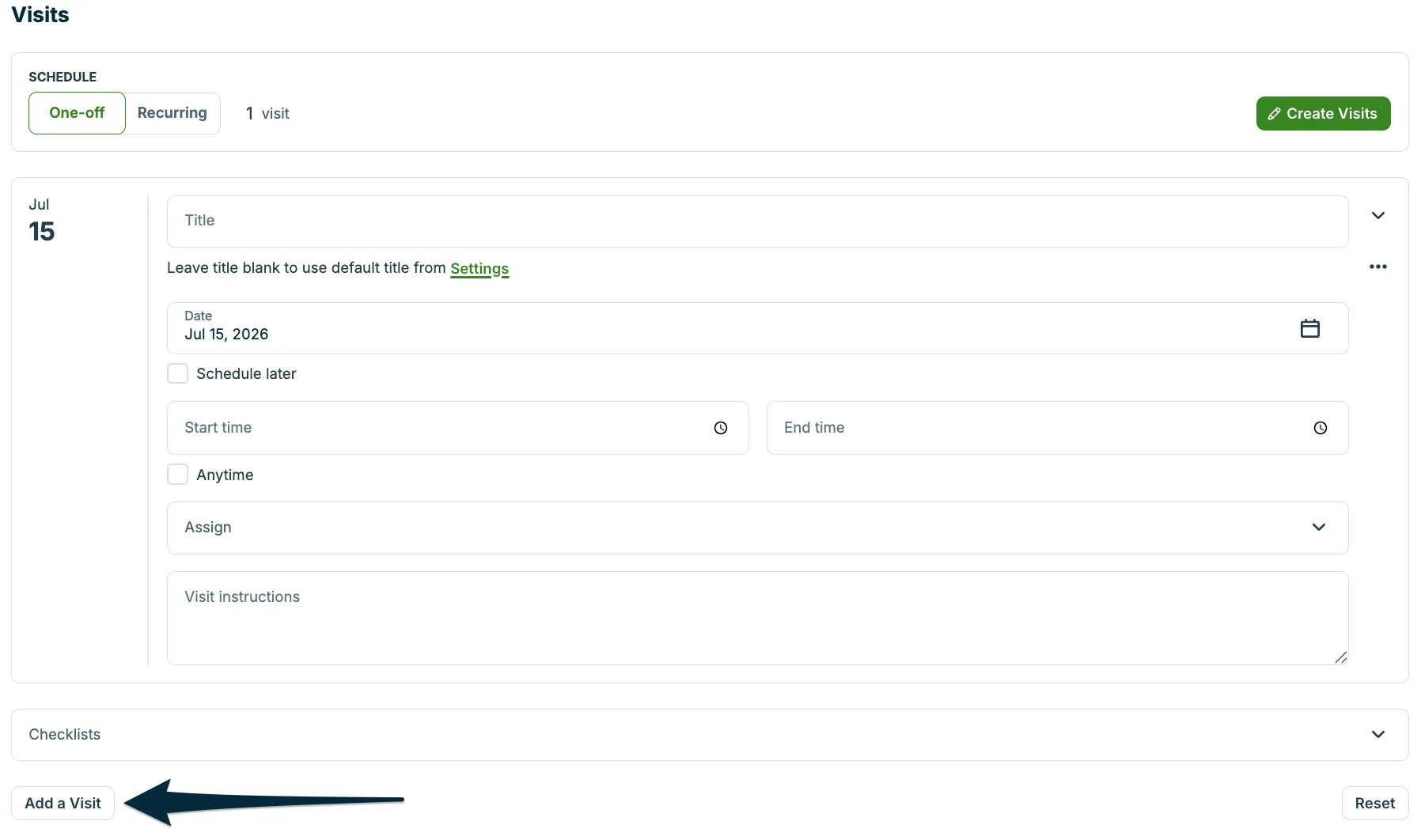
To apply the same time and team to all visits for this job:
- While creating the job, enter the details on a specific visit:
- Select start and end times for the visit. If you leave the time blank, the visit becomes an anytime visit — it has a date but no specific time on that day.
- Use the Assign dropdown to add team members who will be completing this work. If no one is assigned, the visit stays unassigned and can be assigned later.
- From the more actions icon (…) select Apply time and team to all.
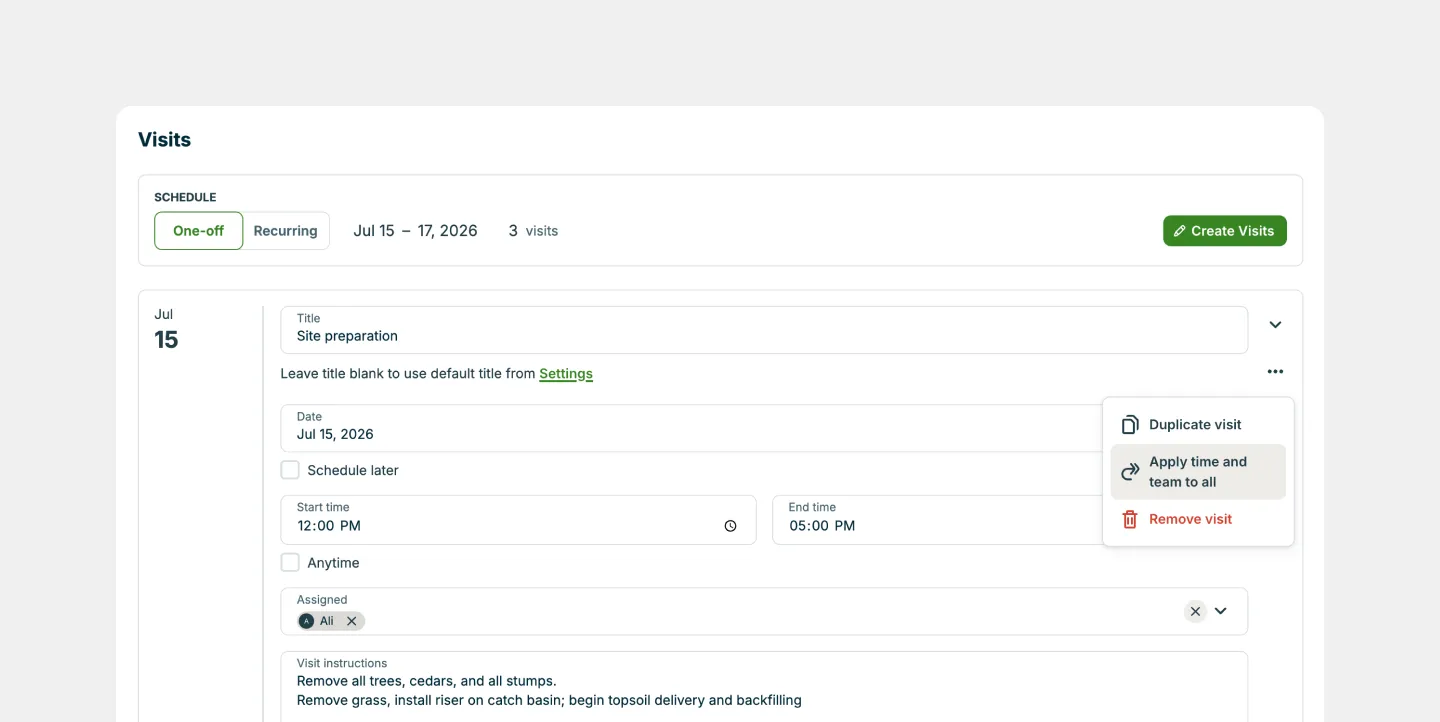
Add additional visits to the job
Once your job has been created, visits can still be added (afterall, scope changes happen!)
Add visits to a saved job:
- From the job page, scroll to the scheduled visits section.
- Click the plus icon then select either Add Single Visit or Add Multiple Visits.
- For a single visit, enter the date, start time, and team members. As well as any instructions for the team completing this work.
- For multiple visits, select your visit dates. From the date picker, choose between the options for Select range to select a continuous range of dates, or Custom select to schedule visits on particular days.
- Once your dates are selected, click Create to schedule the visits.
- Now that your visits are created, click each visit to expand the details. Each of these visits can be edited to add the start time, assigned team, and visit instructions. You can apply the same details to all visits at once, or customize each visit individually.
Set up your billing schedule
When creating or editing a job, you choose how and when invoices are created.
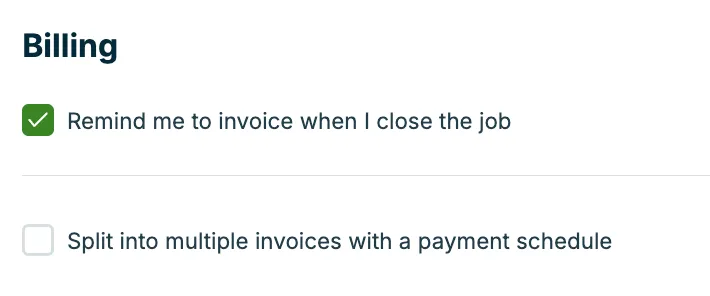
Remind me to invoice when I close the job
By default, Remind me to invoice when I close the job is selected. With this option, when the job is closed an invoice reminder will be generated. An active invoice reminder is what puts a job into “requires invoicing” status and allows you to batch invoice this job. This helps ensure you don’t forget to bill for the work after it’s completed.
If you do not want to invoice for this job through Jobber, uncheck the box for Remind me to invoice when I close the job. When completed, the job will then go into “archived” status and you won’t be prompted to invoice for this job.
Split into multiple invoices with a payment schedule
When this option is selected, you can divide the total job cost into multiple invoices based on a payment schedule. This is useful for larger jobs or projects where you want to collect payments in stages (for example, a deposit upfront and the remaining balance later). Learn more about Payment schedules and progress invoicing.
Add your products and services, labor, and expenses
This section of the job includes:
Profit bar
The profit bar appears on one-off jobs on select plans as part of Jobber’s job costing feature. To minimize the profit bar, select Hide Profitability.

Line items
Line items are the products or services you are offering on this job. Line items can be selected from your products and services list, or added as a custom line item for this job.
To add a new line item, from the product / service section, click the button for Add line item.
Note: A job can support up to 100 line items.
For each line item, enter a:
- Name: The name of the product or service.
- Description: A description of the product or service.
- Quantity: How many of this item you’re offering.
- Unit cost ($): The expenses you incur to provide a product or service. This option is available on select plans as part of our markup functionality. Learn more about our current pricing.
- Unit price ($): The amount you charge customers for a product or service.
- Total: This is calculated automatically based on the quantity and unit price for this item.
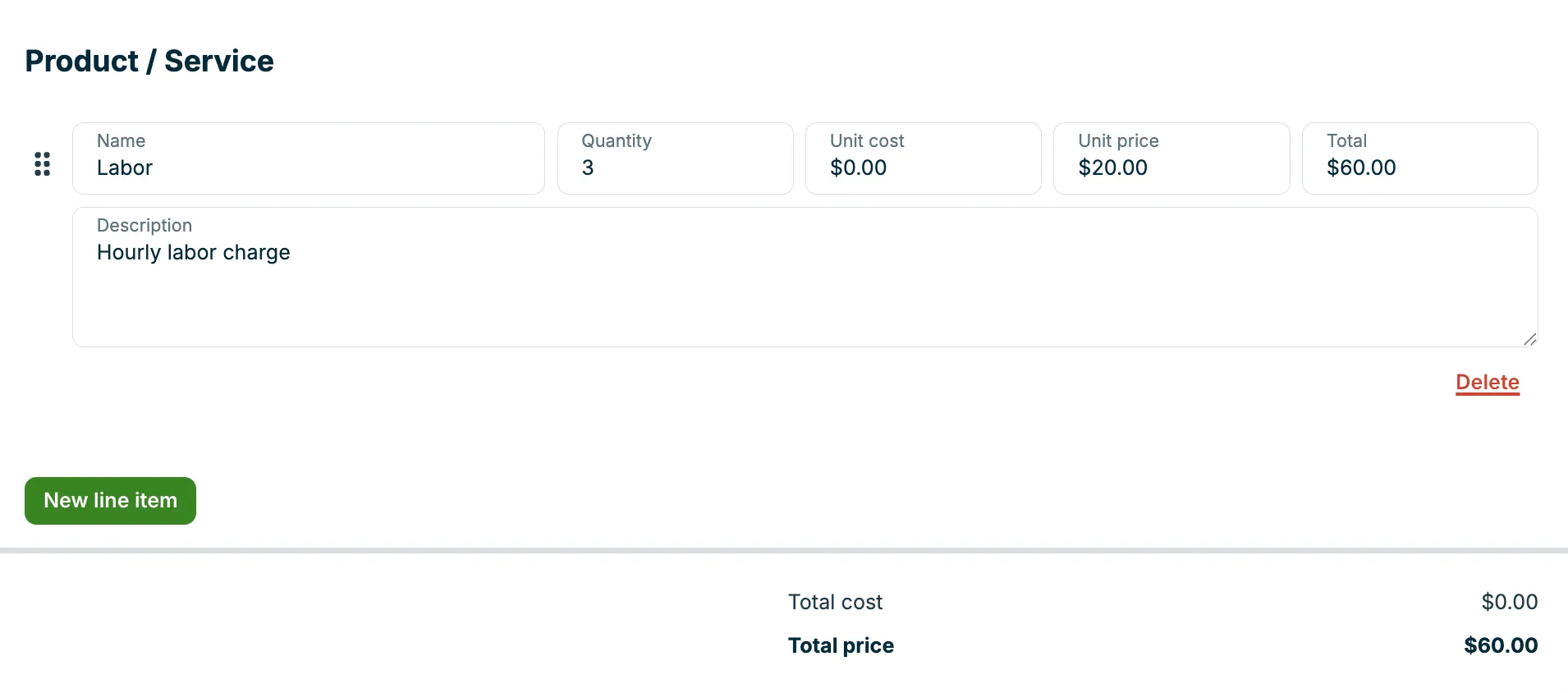
To rearrange invoice line items, hover over the line item then click the 6 dot icon next to the line item’s name and drag to rearrange.
Note: If there is a visit where you need to add additional line items (maybe you require an extra product or are providing an additional service), for one-off jobs these additional line items must be added to the job rather than the visit.
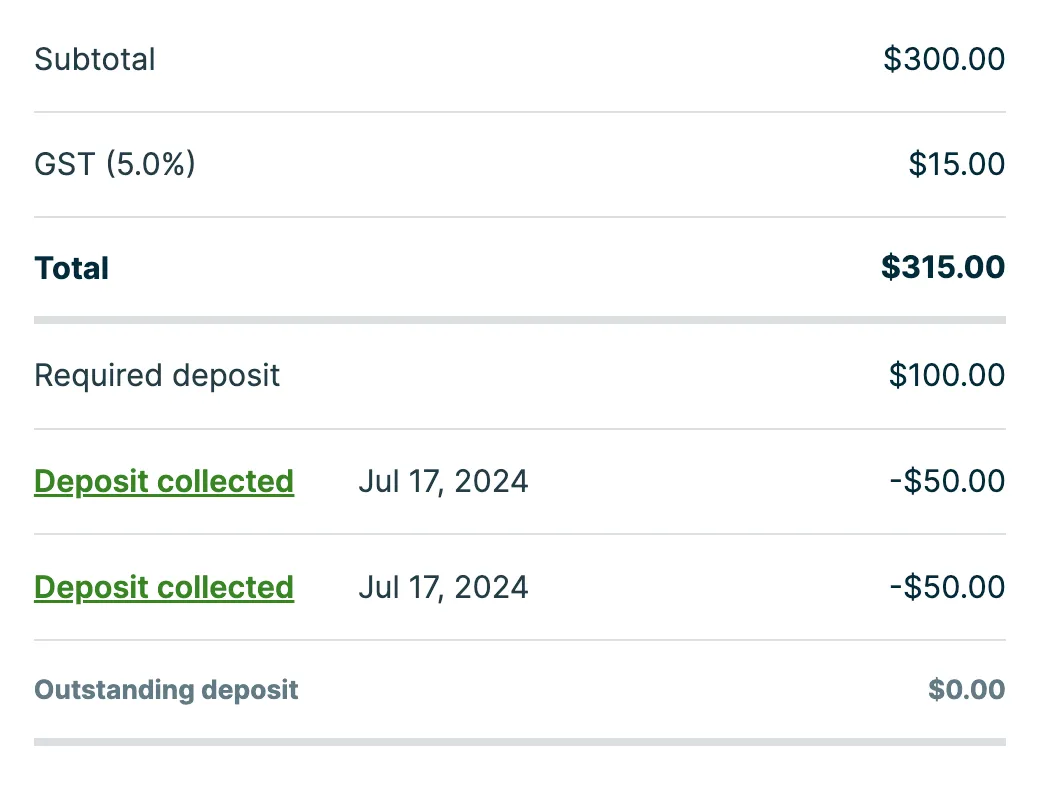
The total of the line items will create the subtotal, then the property’s tax rate will be added to create a total for this job. When a quote with a required deposit is converted to a job, the deposit information will be visible when creating or editing the job. The deposit information does not appear on the saved job, only the create or edit screen.
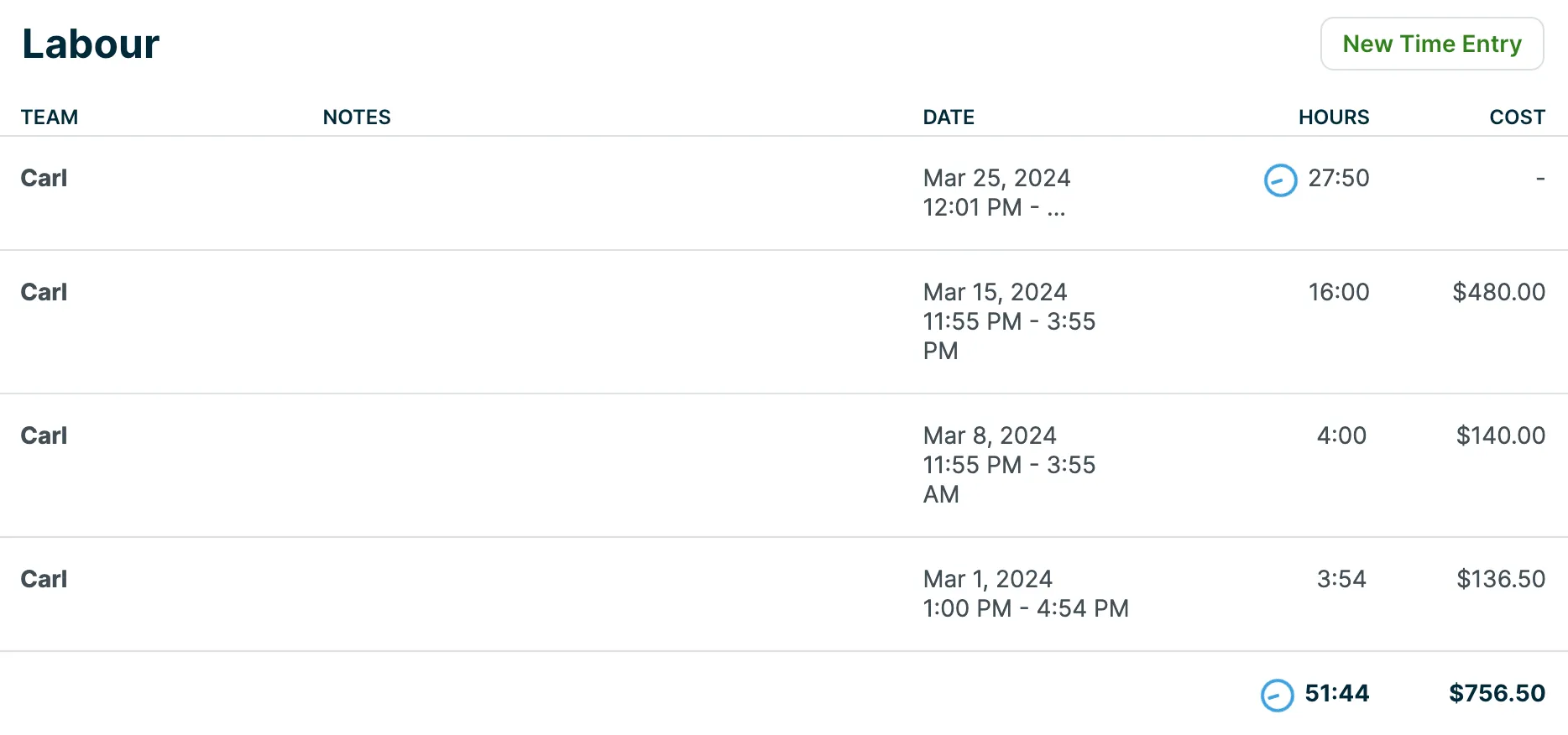
Labor
These are the time entries for your team members who have logged time towards this job. Time entries for this job can be created using the timers in the Jobber mobile app or from Jobber.com by selecting New Time Entry from this job, or from the Time Sheets tab on the side navigation.
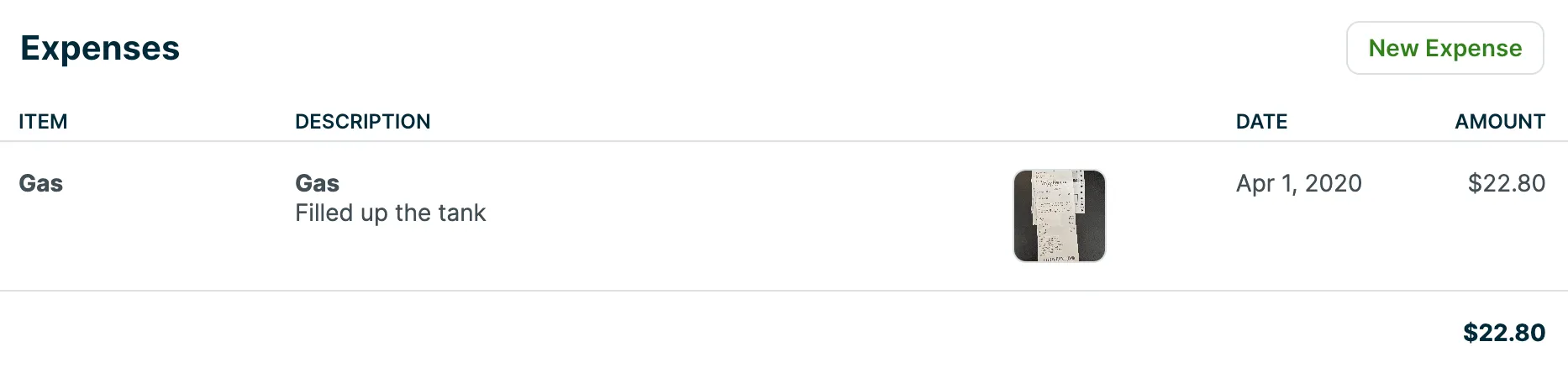
Expenses
These are expenses that have been recorded against this job. To add a new expense to this job, select New Expense.
Job costing
When running a business, it’s important to understand your profitability. There are many factors that go into making a profit, including your pricing, labor costs, and expenses. To make sure that you are staying on track, job costing is available on one-off jobs where you can see your profit margin, profit, and total price.
Job costing is available on the Grow Plan. View our current pricing plans.
To check what plan you’re on, navigate to the Gear Icon then select Account and Billing. If you have any questions about your plan’s features or pricing, our support team is here to help!
Your profitability is calculated using:
- Timesheets - based on the hourly cost of your employees and their time worked on a job
- Line items - including both unit costs and unit prices
- Expenses - these are the expenses logged on a job
Job costs are internal, so your clients won’t see your profits or costs. Only employees with job costing permissions will be able to view the profit bar on one-off jobs.
On one-off jobs, there is a section that includes your line items, timesheets, and expenses which is what makes up the the calculation for your job profitability. At the top of this section is your “profit bar” which shows:
- Profit margin % (calculated by profit / revenue * 100)
- Total price (This is your revenue, calculated as the sum of the line items on the job. This is pre-tax and excludes discounts)
- Total line item costs (This is the total of the line item costs, ie. the cost that you pay for a product or what a service costs you)
- Total timesheets costs (these are your labor costs)
- Total expense costs (these are expenses associated with this job)
- Profit (revenue - total costs)
- A visualization of the line item cost, labor, expenses, and profit
These calculations are for this job only.
To populate the profit bar, click Calculate Profitability. Note that this will not add labor costs or line item costs to the profit bar as these values did not exist before May 4, 2023 when job costing was introduced into Jobber. You can manually edit the costs for the job to add them in.
To minimize the profit bar, click Hide Profitability. When hidden, to view the profit bar, click Show Profitability.
Add internal notes and attachments
You can also add notes, photos, or attachments for your team to see in the Internal notes & attachments section. Clients cannot see these notes.
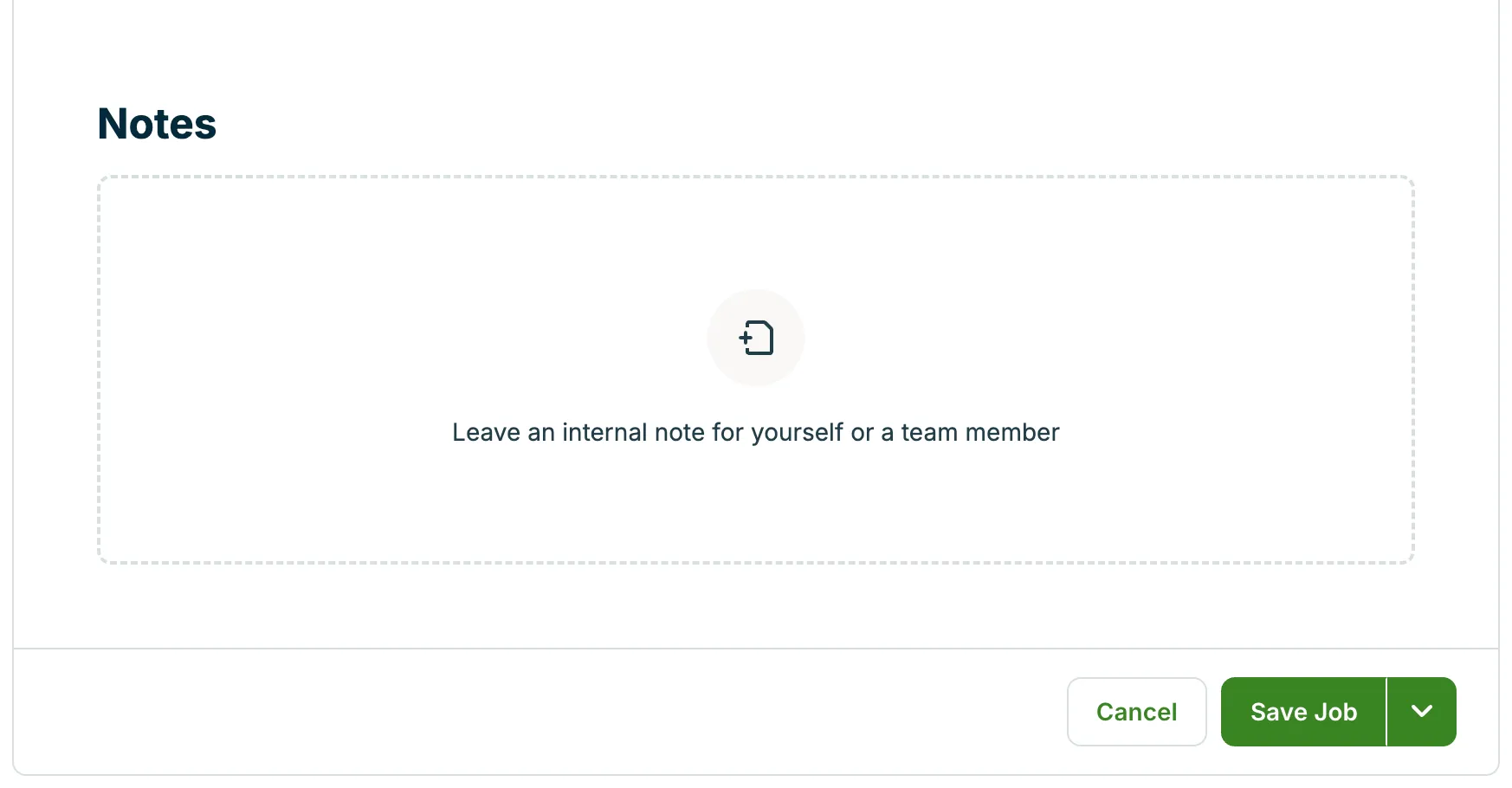
Learn more about internal notes and attachments.
Save the job
Lastly, make sure you save the job! When creating a new job, there are two save buttons:
- Save job will save this job and then take you of of the edit screen, back to the top of the job so you can look over the changes you have made.
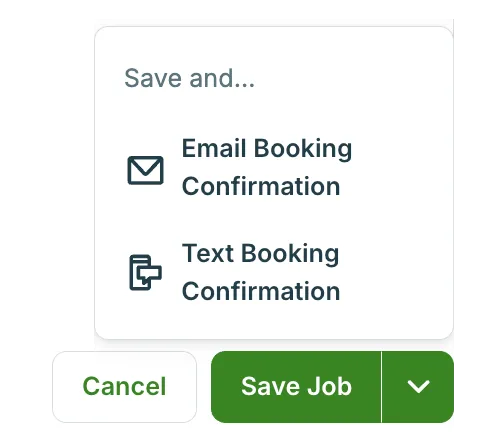
- Save and… has a menu with options to save the job as well as another action, all in one click.
- Email booking confirmation sends a booking confirmation to the client via email.
- Text booking confirmation sends a booking confirmation to the client via text message.
Make edits on jobs
You can update a job directly from the job page.
To edit a job:
- Click Jobs from the side navigation and locate the job you want to update.
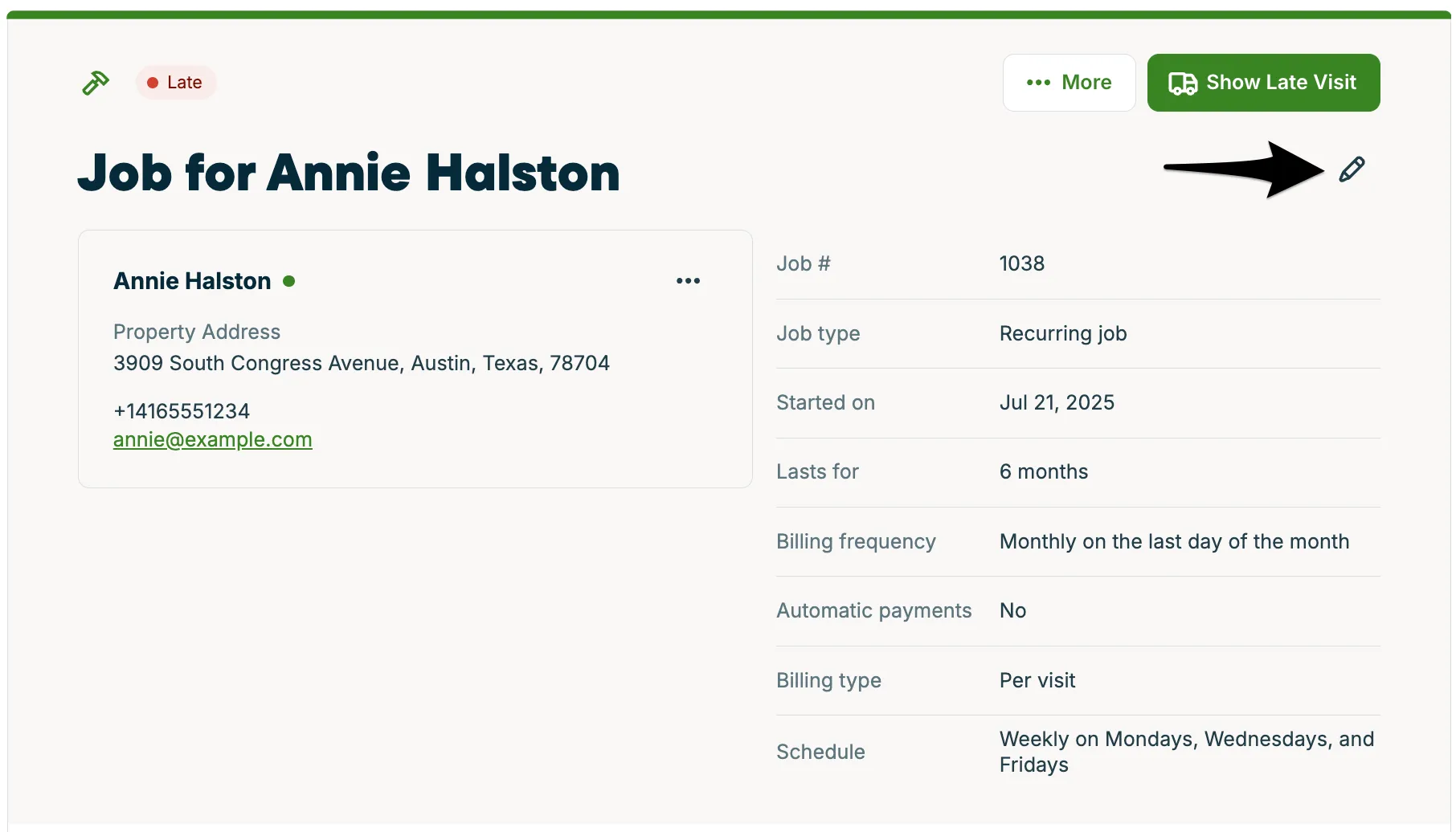
- On the job page, find the section you want to edit, then click the pencil icon in that section.
- Make your changes.
- Click Save.
Repeat these steps for any other section of the job you want to update.
You can edit each part of the job individually, so it’s easy to update specific details without leaving the job page.
Move multiple visits on a one-off job
To move multiple visits from a one-off job to future days:
- Sign in to Jobber.com
- Select Jobs from the side navigation, then select the job from the list and open it.
- From the job, scroll to the scheduled visits section.
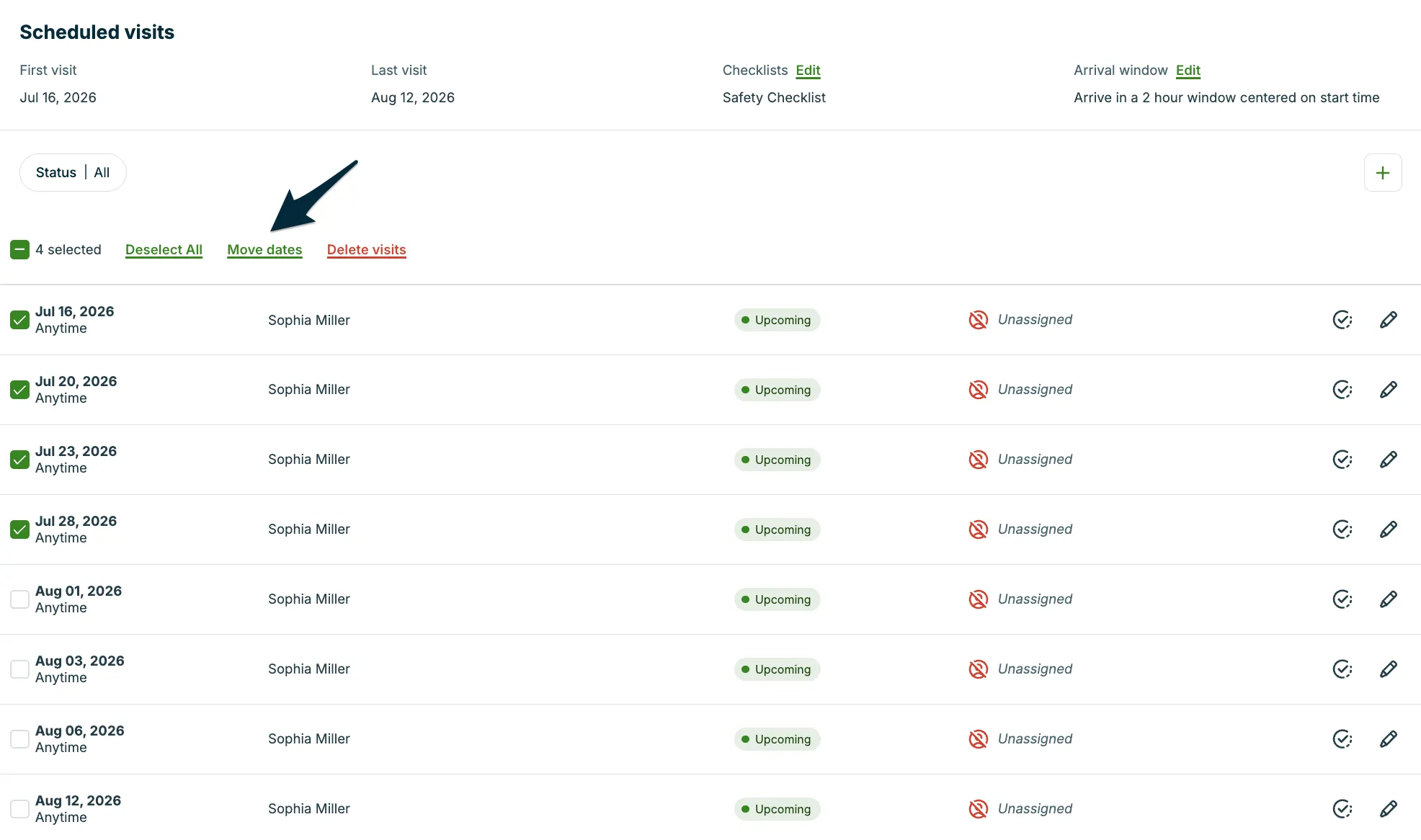
- Check the box next to any visits you wish to move, then select Move dates.
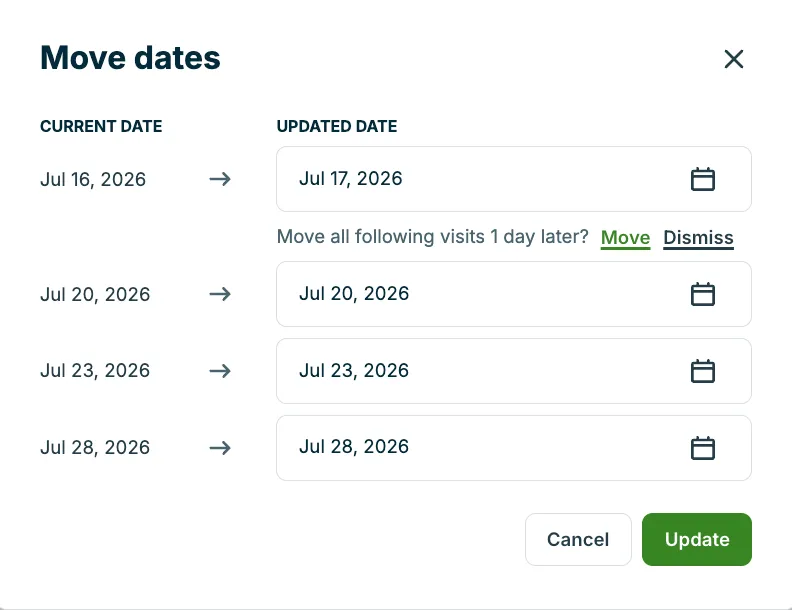
- From the pop-up, adjust the date that you want to move each visit to. When you make the update on the first visit, you will be asked if you want to move all visits by the same number of days. Select Move to apply that change to all visits, or select Dismiss to remove the date you added.
- Click Update.
Note: Only one-off jobs can be moved using this method.