

Overview
Invoices are how you request payment for the work you’ve completed. In Jobber, invoices let you clearly outline the products and services you’ve provided, along with the total amount due, payment terms, and how your client can pay.
You can create invoices from multiple places (like jobs, clients, or invoice reminders) making it easy to bill work as soon as it’s ready. Once created, invoices can be customized, sent by email or text, and tracked through different statuses so you always know what’s been paid and what’s outstanding.
If you’re using Jobber Payments, you can also offer automatic payments—so invoices are created and charged automatically using a client’s saved payment method, helping you get paid faster with less manual follow-up.
With Jobber’s invoicing tools, you can stay organized, streamline your billing process, and get paid faster.
Where to create an invoice in Jobber.com
Invoices in Jobber can be created from:
- The create button on the side navigation menu
- A client’s profile
- An invoice reminder
- A job
Create an invoice from the create button
To create an invoice from the create button:
- Sign into Jobber.com
- From the side navigation menu, click Create then select Invoice.
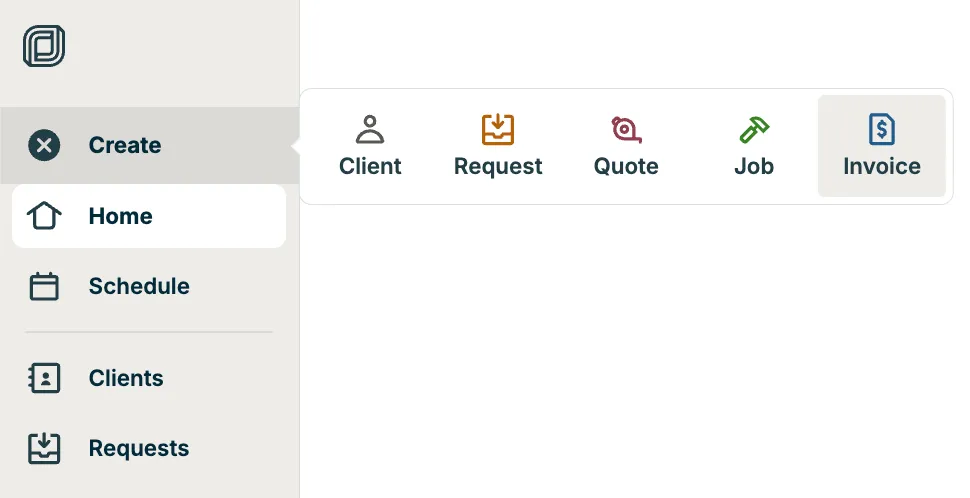
When you create an invoice using the Create button, the invoice is created from scratch and not linked to a specific job.
Because of this:
- The invoice won’t be connected to job details or job progress.
- A property address won’t be included automatically.
- Line items will need to be added manually instead of being pulled in from a job.
This option is useful for one-off charges, standalone services, or any work that isn’t tracked through a job in Jobber.
Create an invoice from a client’s profile
To create an invoice from a client’s profile:
- Sign into Jobber.com
- Navigate to the client’s profile (you can for the client in the search bar on the top navigation menu).
- Click the Create button then select Invoice.
From the client’s profile, when you create an invoice using this method, you may see multiple jobs in a “Requires Invoicing” status. You can choose which of these jobs to include, and all selected jobs will be combined into a single invoice.
On the invoice, the header will display:
- The property addresses (where the work was completed) for each selected job
- The corresponding job numbers
Note: Property addresses only appear when an invoice is created from a job. While invoices are always tied to the client’s billing address, since a job was completed the property address is included for reference.
If the client does not have any jobs ready for invoicing, you can still create an invoice directly from their profile and manually add details like service dates and line items. In this case, because the invoice is not created from a job, the property address will not appear—only the client’s billing address will be shown.
Create an invoice from an invoice reminder
An invoice reminder is a scheduled prompt that tells you when it’s time to create an invoice for a job. It’s set based on your invoicing schedule (for example, after each visit, upon job completion, or at a specific date), and appears on your calendar so you know exactly when to bill your client.
When an invoice reminder becomes due, the job moves into Requires Invoicing status. Which makes it easy to find and create invoices, or batch invoice multiple jobs at once.
You can view invoice reminders and create invoices from the schedule, or from the billing section of a job.
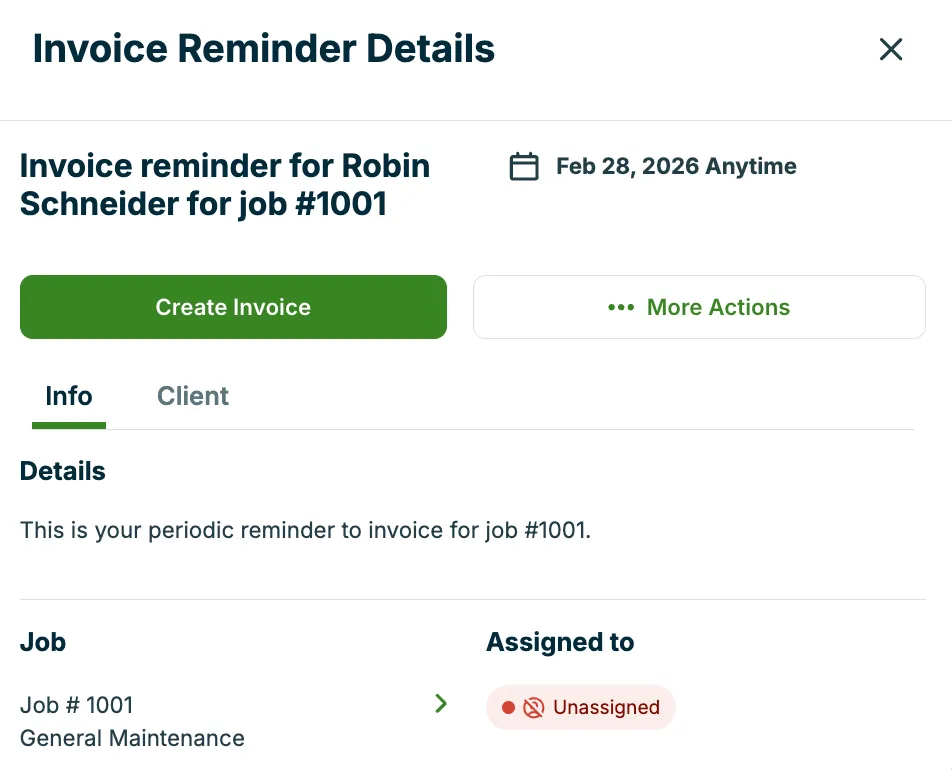
Create an invoice from the schedule (using an invoice reminder):
- Sign into Jobber.com.
- Select Schedule from the side navigation.
- Navigate to the date of the invoice reminder.
- Click the invoice reminder on the calendar.
- Click Create Invoice.
- Review the invoice details.
- Click Save or Save and Send.
Create an invoice from a job (using an invoice reminder):
- Sign into Jobber.com.
- Select Jobs from the side navigation.
- Select the job to invoice for.
- Scroll to the Billing section on the job.
- Click the Reminders tab from the Billing section.
- Click on a reminder from the list to open the details.
- From the invoice reminder details, click Create Invoice
- Review the invoice details. Click Save or Save and Send.
Create an invoice from a job.
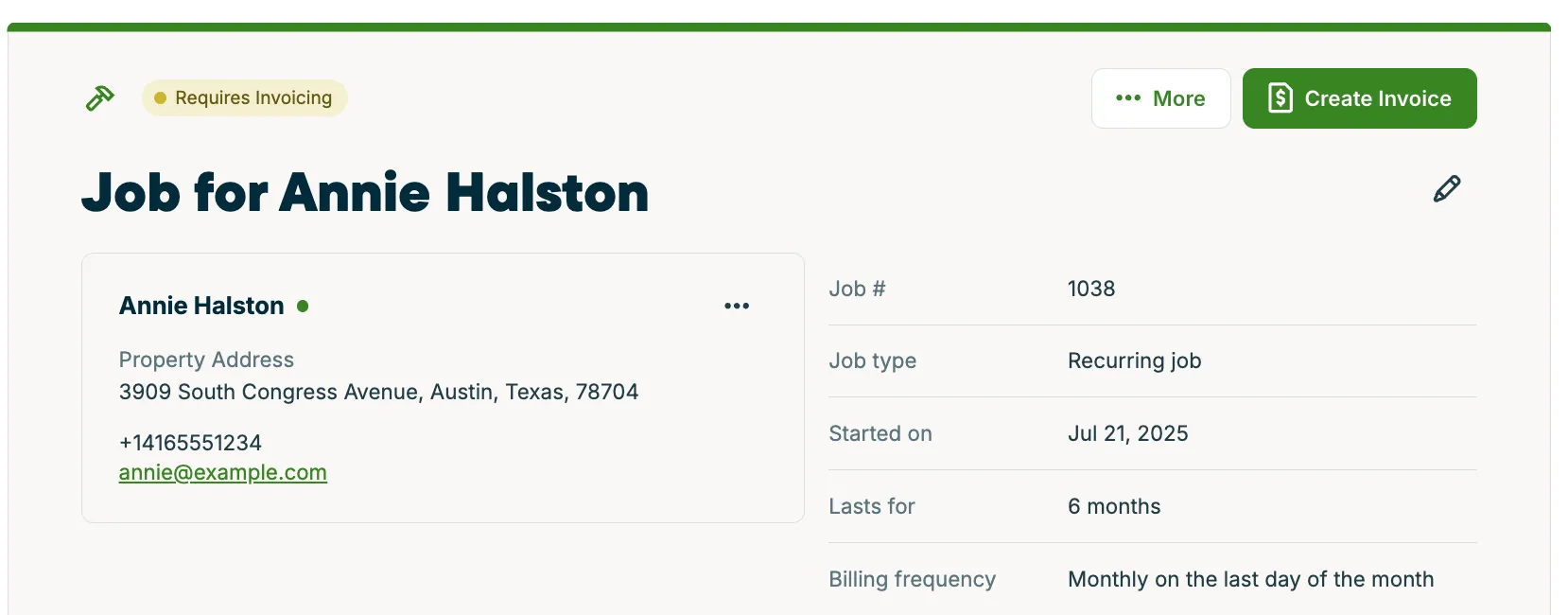
If the job is already in “Requires Invoicing” status, there will be a button on the job for Create Invoice.
If the job is another status, click the More button then select Create Invoice to generate an invoice for this job.
After selecting Create Invoice, if the client has other jobs in “Requires Invoicing” status, you’ll see an option to include them on the next screen.
Select any jobs you’d like to add to this invoice. Jobs you leave unchecked won’t be included, but can still be invoiced later.
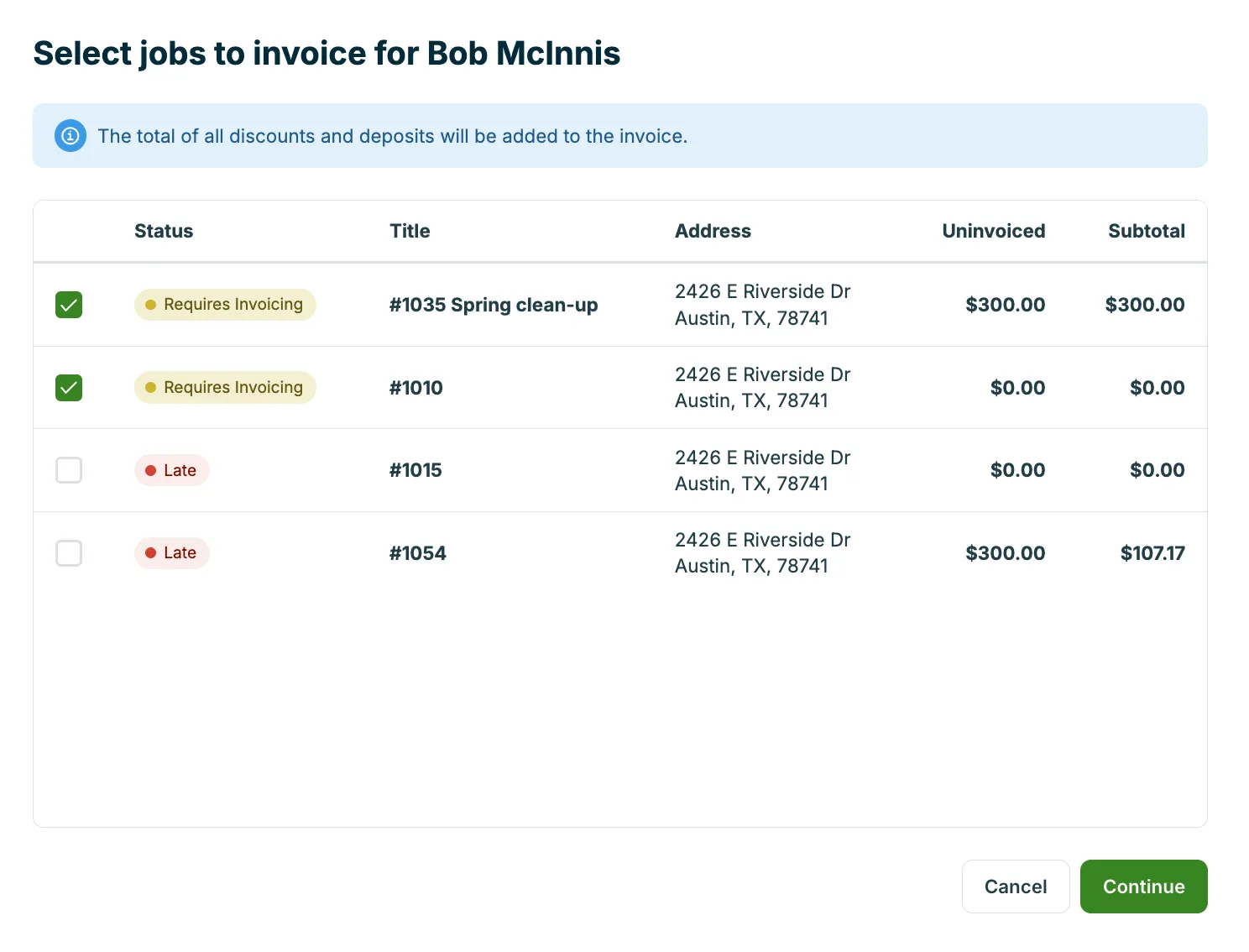
After you click Continue, you will be taken to the invoice creation screen where you can fill out the details for the invoice.
The service dates and service address from the job will be transferred over to the invoice.
Build the invoice
Depending on the method you used to create the invoice, some of the information might already be filled in for you, like the client name or line items, if you’re invoicing from a job.
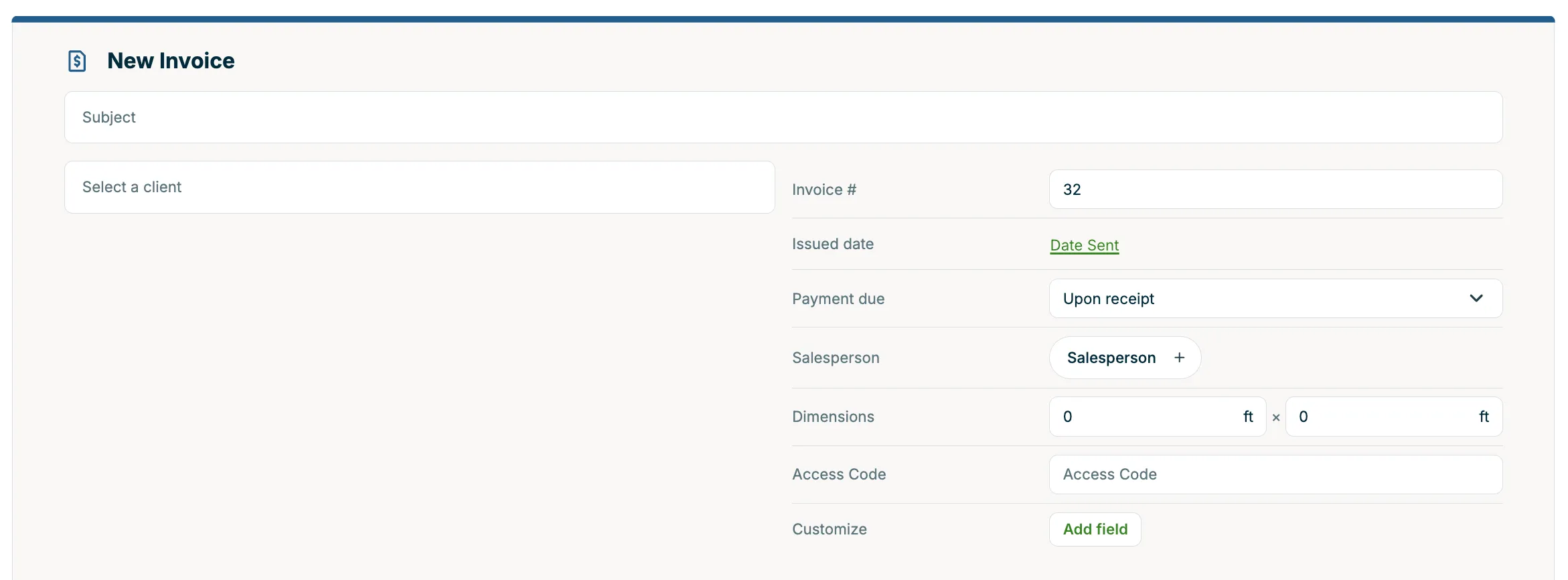
When creating an invoice, at the top (in what will be the invoice details section), you can:
- Select a client: Choose which client this invoice is for
- Include a subject for the invoice: When no subject line is entered, the default subject line from your work settings will be applied.
- Set an invoice number: Enter the number to use for this invoice. By default, this will count up from the highest invoice number in your account.
- Select when the payment for this invoice is due: Use the dropdown to select your payment terms. Your default terms selection can be customized in your work settings.
- Select the issued date: Click Date Sent to change the date this invoice was issued. By default, the issued date will be the day the invoice was sent (either by text message or email), or marked as sent.
- Add a salesperson: Click the Salesperson dropdown to select a team member.
- Fill out custom fields: Custom fields on invoices will be visible when creating the invoice. Enter any relevant details into the custom fields.
- Add a new custom field: Select the Add field button to create a new invoice custom field. This custom field will be an option on new invoices created going forward.
In the middle, is the products and services you’re charging for:
Use the Product / Service section to list what you’re charging your customer for. Each line item represents a product, service, or type of work.
Click Add Line Item to include a new product or service on the invoice.
Note: An invoice can support up to 100 line items.
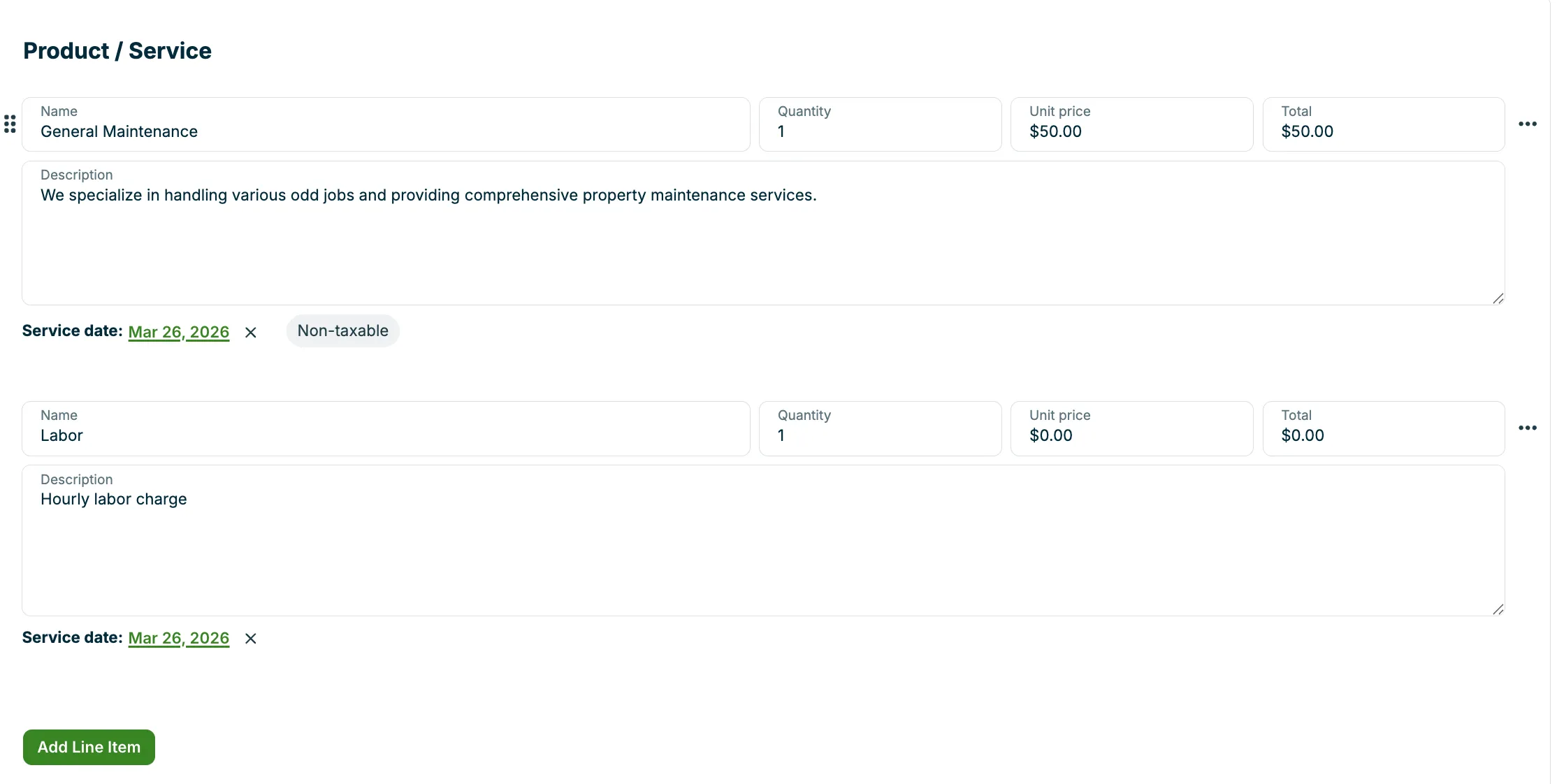
For each line item, you can fill in:
- Name: The title of the product or service (e.g., General Maintenance, Labor).
- Description: Add more details about the work performed. This helps your customer understand what they’re being billed for.
- Quantity: How many units of the item you’re charging for.
- Unit price: The cost per unit.
- Total: Automatically calculated based on quantity × unit price.
Note: Some line items may show they are “non-taxable”. This indicates whether tax is charged on this line item. Taxable status for individual line items is managed in your Products & Services List.
Each line item also includes a Service date, which shows when the work was completed. Use this to reflect when the service actually took place, especially if it differs from the invoice date. Click Add Service Date to manually add a service date for the line item.
To rearrange invoice line items, hover over the line item then click the 6 dot icon next to the line item’s name and drag to rearrange.
To remove a line item from the invoice, click the three dots (also called more actions) beside the line item, then select Delete.
At the bottom of the invoice, you can:
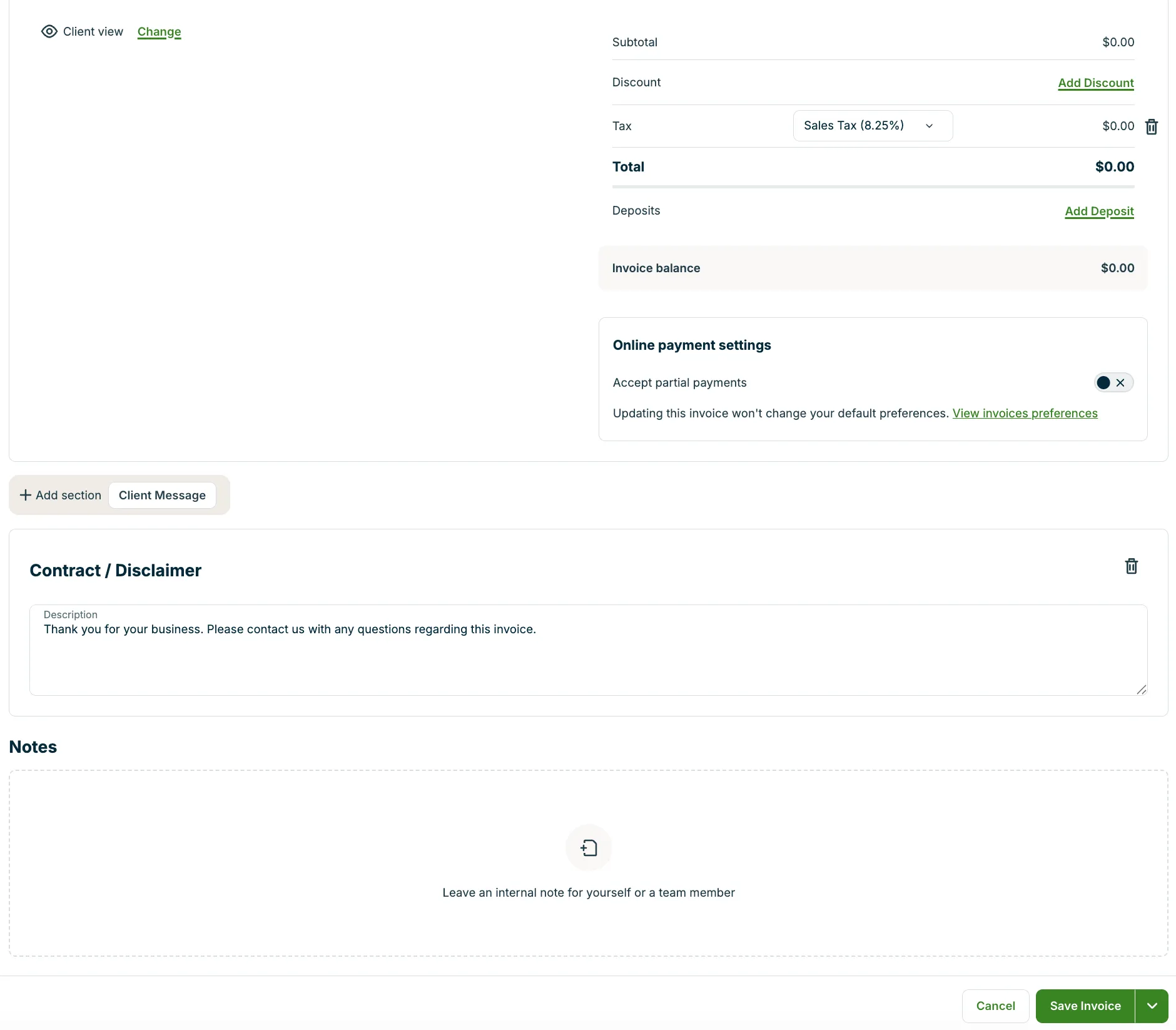
Finalize the invoice total:
- Select Add Discount to add a discount to this invoice
- Edit the tax rate for the invoice. Your tax rate options are managed in your Company Settings.
- Select Add Deposit to record a new deposit or select a deposit from the client’s account balance
- Select the invoice payment options:
- Card payments: When this is toggled on, your client will be able to pay this invoice online using a credit or debit card. When this is toggled off, your client will not have the option to pay this invoice using a card.
- Bank payments (ACH): When this is toggled on, your client will be able to pay this invoice online using a bank payment (ACH). When this is toggled off, your client will not have the option to pay this invoice using a bank payment.
Note: Canadian Jobber Payments accounts don’t have payment method toggles. This is because Jobber Payments in Canada only accepts card payments. In the United States, Jobber Payments also supports ACH bank payments, which is why U.S. accounts include a toggle for payment methods.
- Select if the client can pay this invoice through partial payments
- To allow partial payments on this invoice, set the toggle for Allow client to make partial payments for this invoice to On. By default, this toggle will be turned off so that your client must pay the invoice in full when paying online in client hub.
See what will be visible to the client: In the Client view section, use the toggles to adjust what your client sees on this invoice. This is where you can set preferences for this specific invoice — including whether quantities, unit prices, line item totals, account balance, or a late stamp (if overdue) are shown.
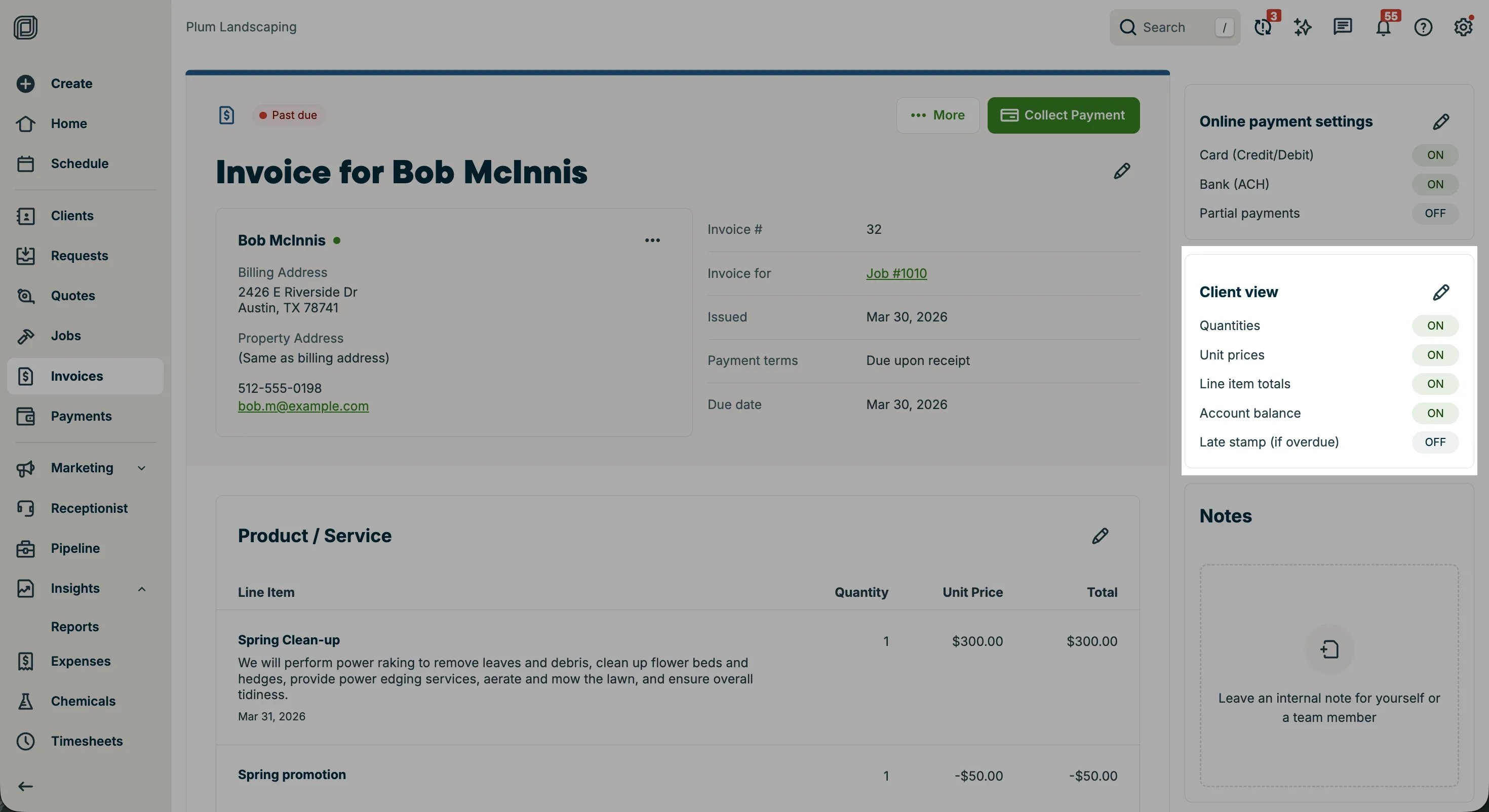
To edit these selections for all future invoices:
- Open the Settings menu (gear icon) and select Settings.
- Select Business Profile.
- Scroll to the Client documentation settings section and select Edit settings.
- Select the Quotes or Invoices tab depending on which you wish to update.
- Deselect the checkbox for that field (for example, Account balance) to hide the field on all future quotes or invoices.
Note: This change won’t retroactively update your existing quotes or invoices. Any existing quotes or invoices will need to be edited individually.

Add a client message for the invoice. Once you’ve entered your message, a Rewrite button will appear. This button uses AI to rewrite the text in the client message field. Select the button to rewrite the text to be more:
- Cheerful
- Casual
- Professional
- Shorter
Add a contract/disclaimer for this specific invoice: By default, the contract disclaimer is pulled from your client document settings, but it can be customized directly on the invoice. Once you’ve added a disclaimer, select Apply to all future invoices to use it on new invoices going forward and replace the contract/disclaimer in your client document settings.
Learn more about how to add internal notes and attachments to invoices.
Add images and attachments to an invoice
On the Grow and Plus plan and through Marketing Suite, files and media from your library can be added directly to an invoice to share with your clients. For example, you may want to include before and after photos, warranties, or completed inspection records.
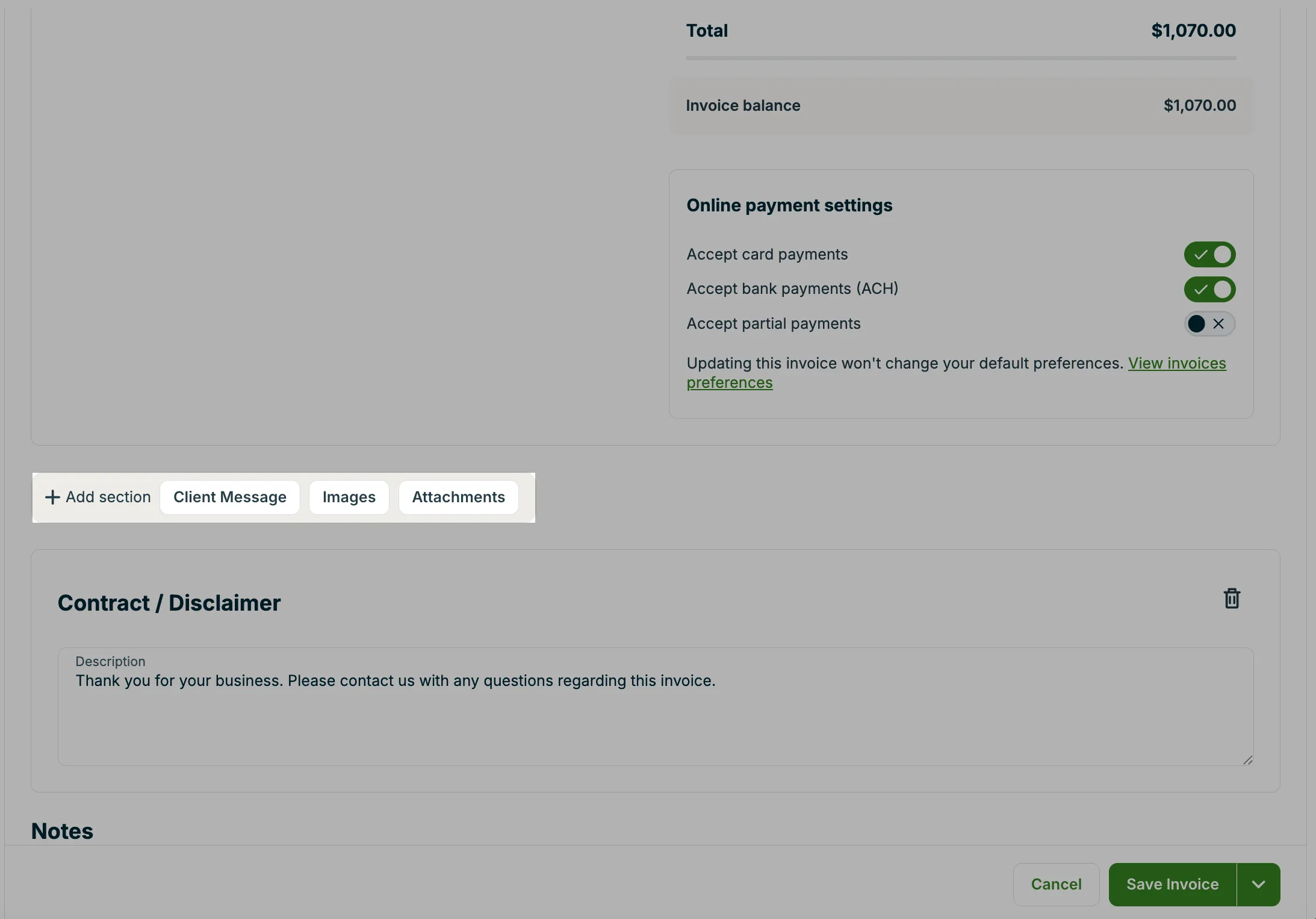
On the Plus plan, the Images and Attachments fields open automatically the first 3 times you view an invoice’s edit screen, along with a suggested media area recommending images and files already associated with that invoice. After the third view, the fields no longer open automatically, and you’ll need to add a section for Images or Attachments yourself, following the steps below. The suggested media area continues to appear whenever Jobber finds associated files, regardless of how many times you’ve viewed the invoice.
Note: This must be done from Jobber.com, not the Jobber app.
To add images or attachments to an invoice:
- Open the invoice.
- Add a section for Client message, Images, or Attachments.
- Depending on your selection, a new section appears on the invoice.
- To upload a file from your device, select Upload.
- To use a photo or file already stored in your Jobber account, select Choose image or Choose file to open the file picker and select from your existing media.
- Enter a keyword in the Search files bar to narrow the results. You can also use the filters.
- Select the file you want to attach.
- Select Save or Update Invoice to apply your changes.
Search looks at information linked to the file, such as the name of the job, quote, or invoice it’s connected to, not just the file’s name. It also matches partial words.
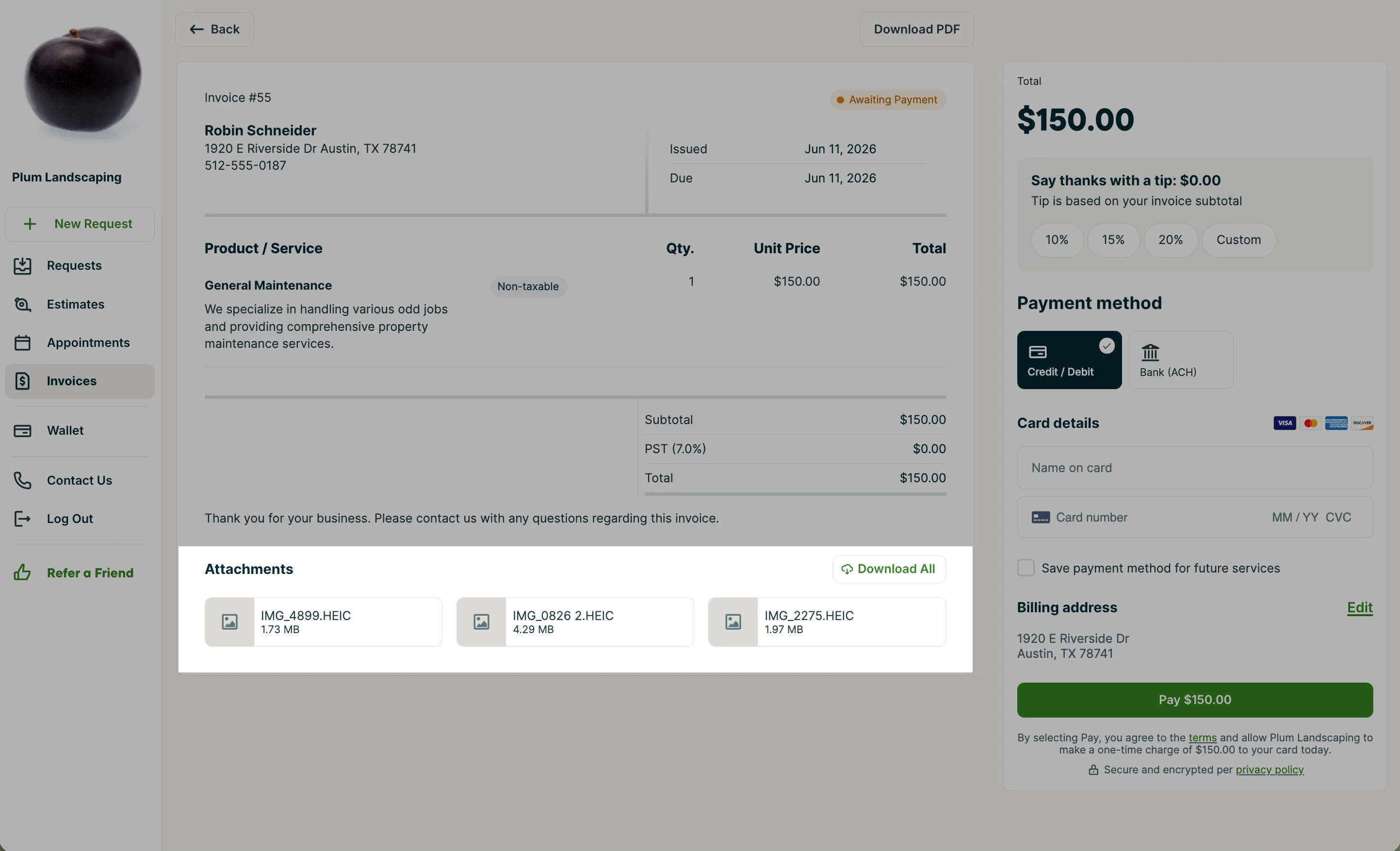
Note: Images appear in the Images section and are visible to your client through client hub. Attachments can include non-image files such as PDFs and documents, and are also accessible through client hub. This must be done from Jobber.com, not the Jobber app.

Images and files attached directly to an invoice do not display inline in the PDF. Instead, the PDF lists the attachment filenames and includes a link to client hub, where your client can view or download the files.
If your client needs to access the attachments, direct them to the invoice link in client hub.
Save and update invoices
When you save an invoice for the first time, there are two options:
- Save Invoice: This saves the invoice and takes you out of the edit screen, back to the top of the invoice where you can review the invoice details. The invoice will be saved as a draft.
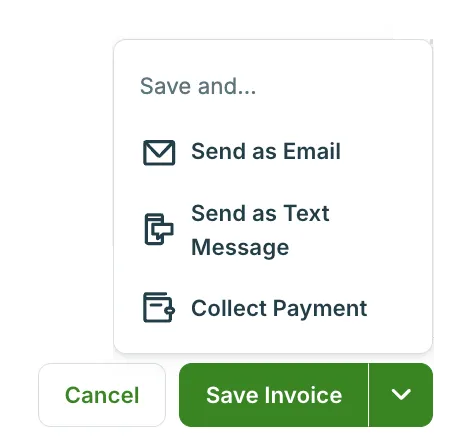
- Save and…: Clicking this button gives you a list of other actions you can do in addition to saving the invoice. These are things that might save you a step or a few clicks. Your options are to:
- Send as Email: The invoice is saved and emailed to the client. Emailing an invoice removes it from draft status.
- Send as Text Message: The invoice is saved and sent to the client as a text message. Texting an invoice removes it from draft status.
- Collect Payment: The invoice is saved and you are prompted to record a payment. If the payment recorded covers the invoice balance in full, the invoice status changes to “Paid”.
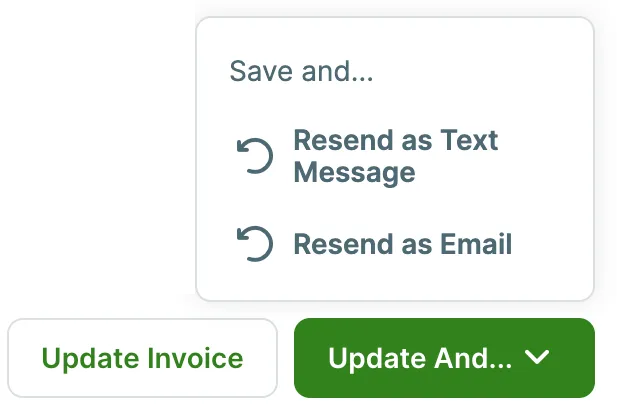
Once an invoice has already been created, the button changes from Save Invoice to Update Invoice. The update options are to:
- Update invoice: The invoice is updated with the changes you have made. You will be taken out of the edit screen and back to the invoice to look it over.
- Update and…:
- Re-send as Text Message: A copy of the invoice with the updated changes is sent to the client via text message.
- Re-send Email: A copy of the invoice with the updated changes is sent to the client via email.
Sending the invoice
Invoices start in draft status. Once you send the invoice (or mark it as sent) it moves out of draft and into either awaiting payment or past due, depending on the due date.
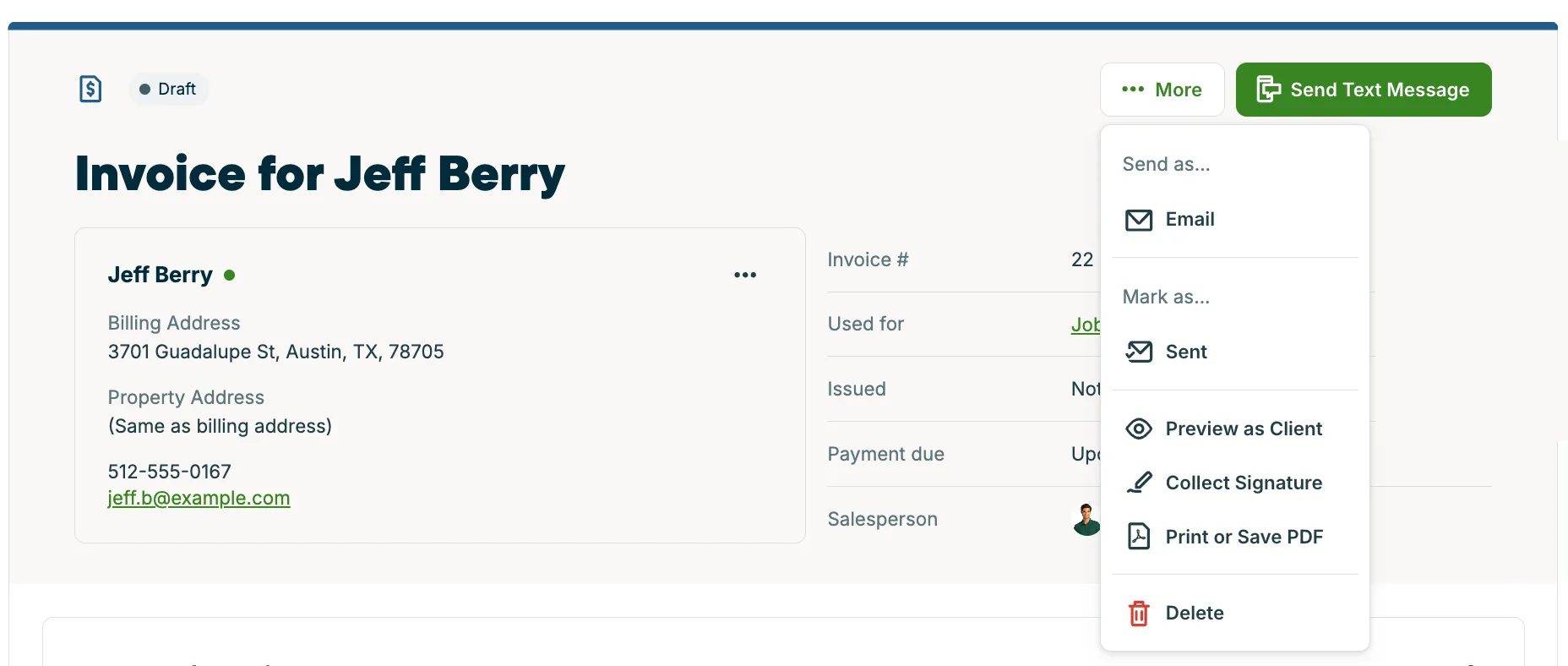
While an invoice is still a draft, the primary button is Send text message. You can also choose Email or Mark as sent from the More menu.
Email an invoice
To email an invoice to a client, open the invoice and click More Actions then select Email. Emailed invoices will include a link to view the invoice online in client hub. If you’re using Jobber Payments, there will be a button to pay the invoice.
When you email an invoice to your client, a pop up box will come up where you can preview the message and make edits to this particular email.
The invoice email has two sections:
- Message: The text that appears at the top of the email. You can customize this for all invoices in your template settings, or edit it on a per-invoice basis before you send.
- Payment options: A section Jobber adds automatically that shows your client how to pay the invoice, including any Jobber Payments methods you have set up. This section is part of the email design and cannot be edited.
To update the default message for all invoice emails:
- Navigate to Settings, then select Emails and Text Messages.
- Under Invoices, select Edit next to New invoice.
- Update the message, then select Save.
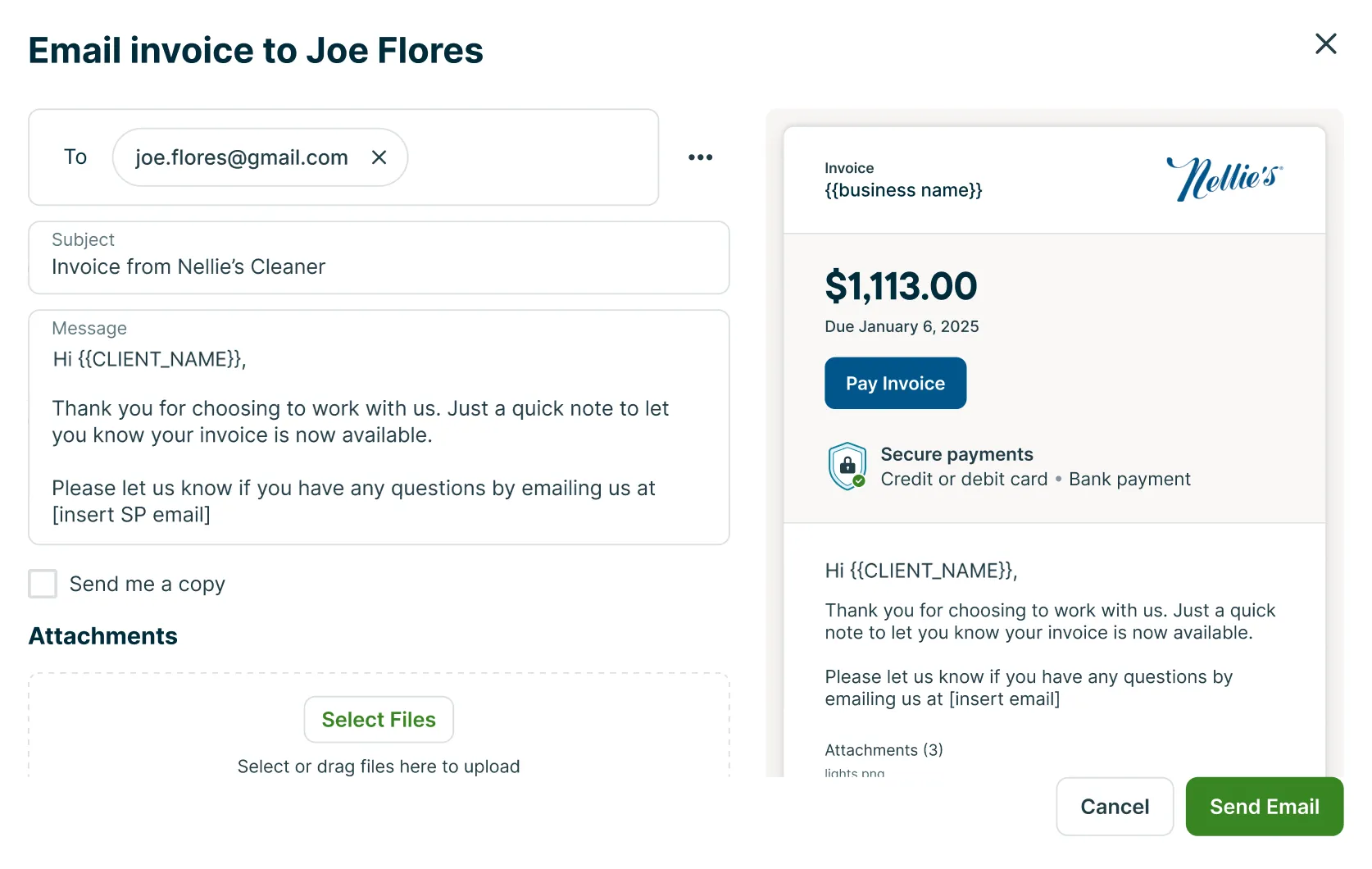
To change the recipients of this email, click … beside the To field. You can then change the email, or add other emails to send it to.
Other actions you can take before clicking Send Email:
- Manually edit the email body to provide more or less information to your client
- Check the box to Send me a copy to BCC yourself on the outgoing email
- Add Attachments from the right of the pop-up. Attachments can be uploaded from your computer or you can choose attachments that have been added to the internal notes and attachments for this client. Attachments must total under 10MB.
- Note: When emailing an invoice to a client, if you would like to include the invoice PDF as an email attachment, in the attachments section of the email preview screen, make sure to check the box to include the PDF as an attachment. By default invoice PDFs are not attached to the email and your client will be prompted to view the invoice in client hub where they can view and pay the invoice. If you have not included the invoice PDF as an attachment and your client would like a PDF copy, they have the option to download one from client hub.
- Customize your default templates - update what the default invoice email looks like as well as other email and text templates.
Text an invoice
Text message delivery is available in the United States, Canada, and the United Kingdom.
To text an invoice to a client, select the Send Text Message button.
Once you select that you would like to send this invoice via text, a pop-up will appear with a preview of the message and a link to view the invoice in the client hub. This link will expire after 24 hours, but the client can still view it by entering the last 4 digits of their phone number to sign into their client hub.
The client’s primary phone number will be the default phone number as long as it is SMS enabled. You can also chose to enter a different phone number or multiple phone numbers.
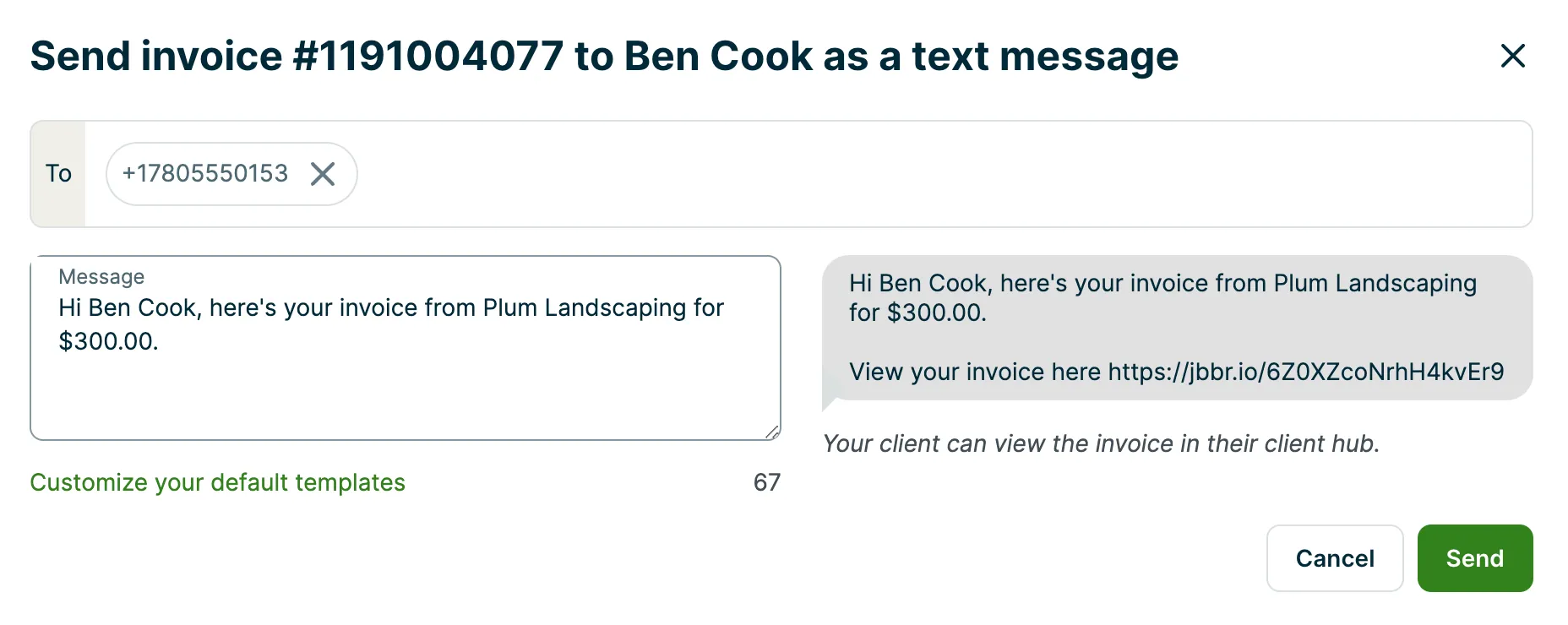
The invoice text message is customizable on an individual level, as well as set up as a template in your emails and text messages settings, found by going to the Gear Icon, then Settings, then select Emails and Text Messages Settings.
Note: There is a 160 character limit for text messages as this is the maximum number of characters that will fit in one text. If you go over this limit, that’s ok! Your message will still be delivered, it just might be in multiple text messages. That being said, most smart phones will recognize when there are multiple text messages and group them together as one message —but this varies based on different devices and cell phone providers.
Collect payment on an invoice
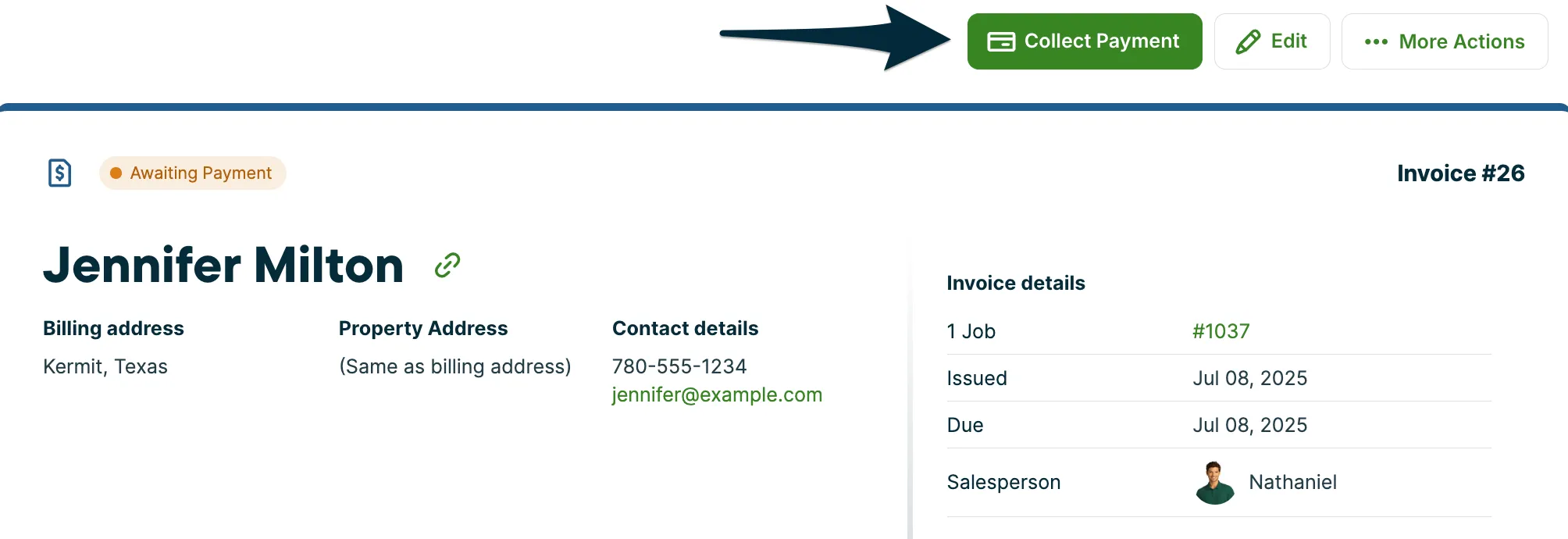
To enter a payment, click Collect Payment.
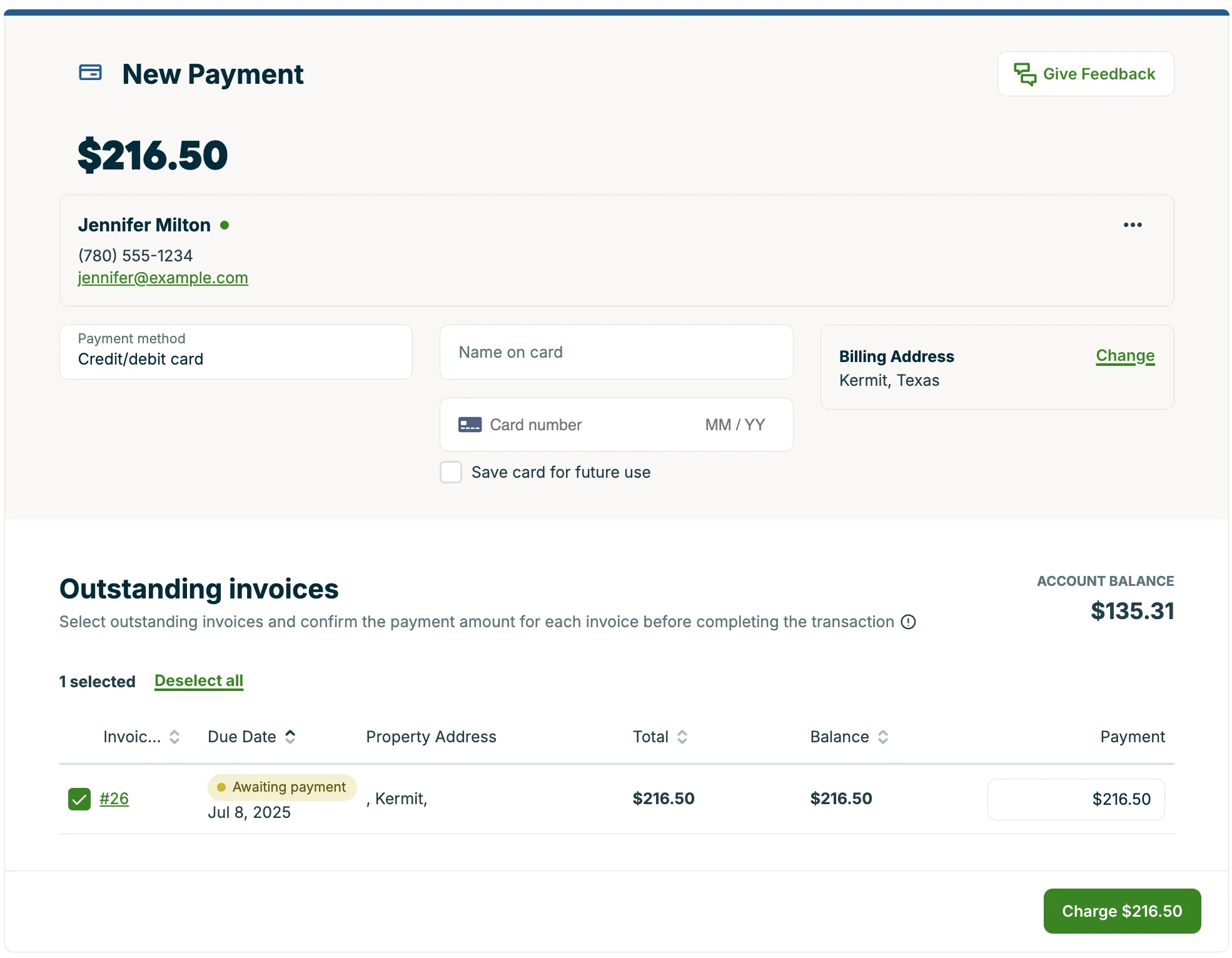
At the top of the payment screen, you’ll see the total to be collected along with the client’s name, contact info, and billing address.
Below that, select the payment method from the dropdown. The form will update with relevant fields based on your selection (e.g., card details or check number).
Next, you’ll see the client’s outstanding invoices. Select the ones you’re collecting payment for by checking the boxes. The table shows:
- Total: Original invoice amount
- Balance: Remaining amount due
- Payment: Amount being collected (editable)
By default, the remaining balance is auto-filled, but you can adjust it to collect a partial payment. The total at the top updates automatically as you make changes.
To complete the payment, click Charge or Save at the bottom—this depends on the payment method:
- Charge: For immediate credit/debit card payments via Jobber Payments
- Save: For recording offline payments like cash or check
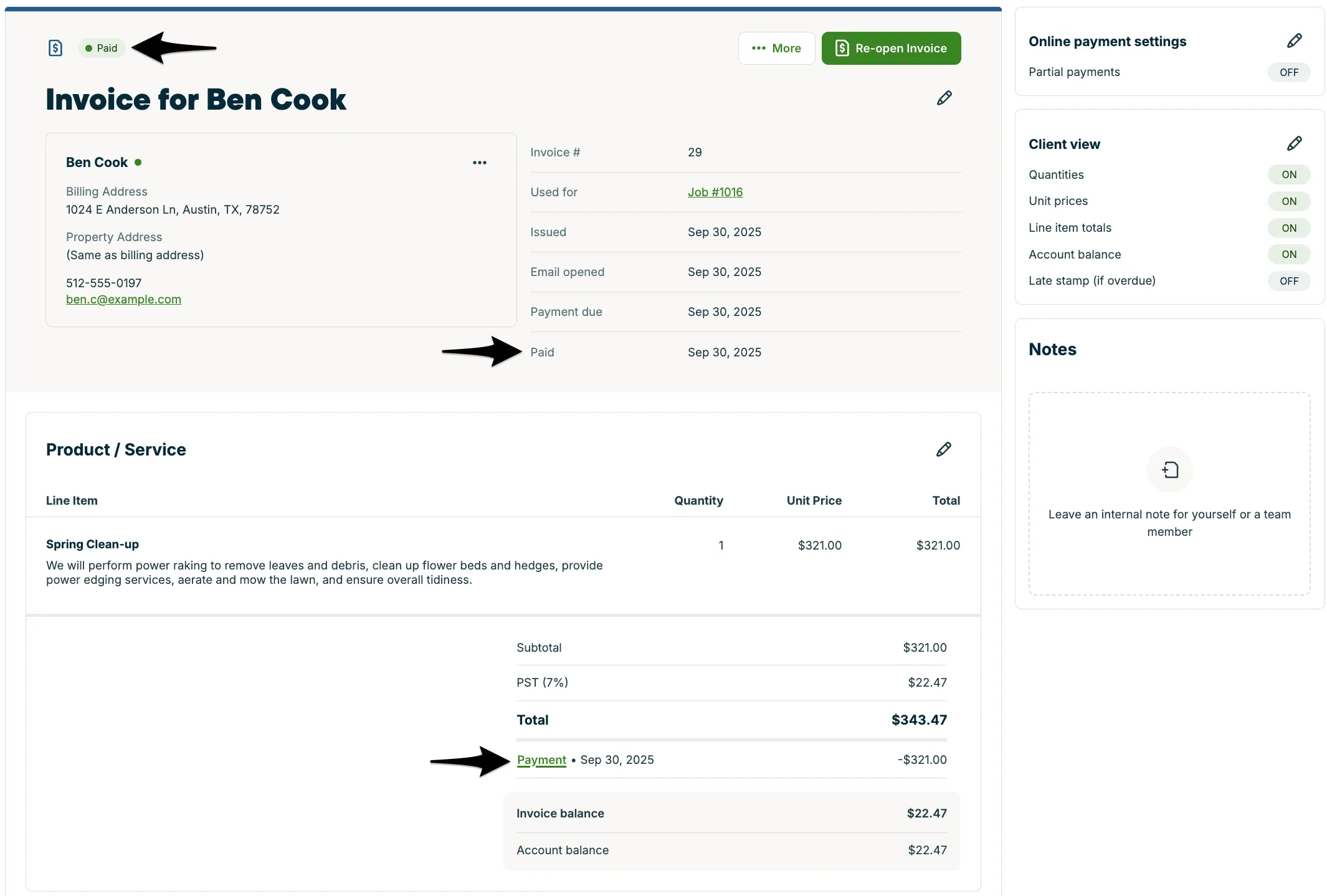
When a payment has been recorded in Jobber it will be listed at the bottom of the invoice and will show the payment date and amount paid. You will see the remaining balance of the invoice, as well as the client’s full account balance. Click the word Payment to open the payment details.
Learn more about Collecting Payments
Invoice statuses
There are 5 possible statuses that an invoice can have and they will show in a label next to the invoice icon at the top left of the invoice. The actions that can be performed on an invoice depend on its status.
The invoice statuses are:
- Draft: The invoice has been created, but hasn’t been sent to a client or marked as sent. A draft invoice will move into the next status when it is sent (either by email or text message), or marked as sent.
- Awaiting Payment: The invoice has been sent to a client, and has not been paid yet. The invoice due date has also not passed yet.
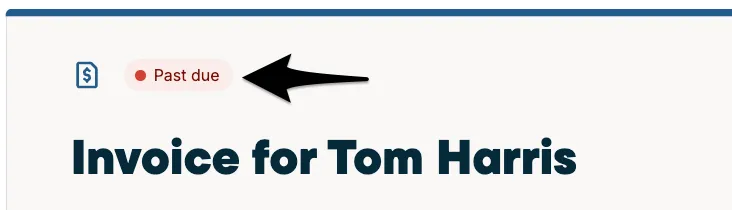
- Past Due: The invoice is past its due date, and hasn’t been paid for, or marked Paid
- Paid: A payment for the full invoice balance has been applied, or the invoice has been manually marked as Paid
- Bad Debt: An invoice in bad debt status has been deemed partly or fully uncollectible. Either part of the remaining balance or the full invoice balance has been marked as bad debt to close out the invoice and remove it from the client’s billing history. The invoice remains in Jobber for your records.
Actions on an invoice
Once an invoice is no longer in draft status, you can take several actions on it.
At the top of the invoice, you’ll see buttons for the primary action, secondary actions, and a More Actions menu. The primary action for a past due or awaiting payment invoice is typically Collect Payment, but you can also edit the invoice or choose from additional options in the menu.
Collect Payment
This appears beside the More Actions button and allows you to enter and apply a payment directly to the invoice. Collecting payments in this was reduces the payment amount from the invoice balance. Once the full invoice balance has been paid through this button, the invoice status will automatically change to Paid. Learn more about how to collect payments on invoices.
Note: Payments can be collected on draft invoices.
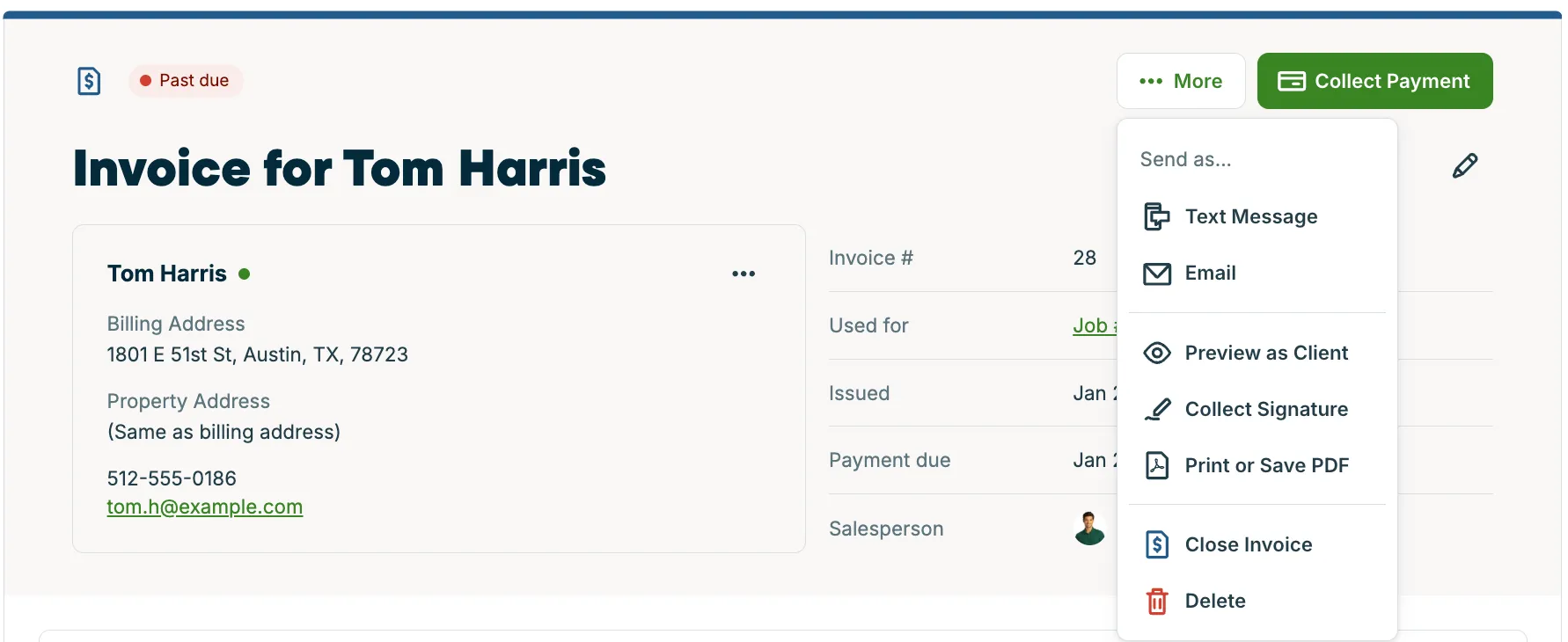
The More menu on invoices has many options including:
- Text Message: This will send the invoice to your client in a text message. The client will receive a text with a link to the client hub where they can view the invoice.
- Email: This emails the invoice to your client. Learn more about sending invoices.
- Create Similar Invoice: Creates a new draft invoice pre-filled with details from the original invoice including line items, subject, client message, contract disclaimer, discount, and custom fields. The new invoice can be the for the same client, or a new one.
- Preview as Client: View how the invoice will look to a client viewing it in client hub.
- Note: This action doesn’t appear if the invoice is in Bad Debt status.
- Collect Signature: This will allow you to collect your client’s signature on the invoice. A PDF of the invoice with the signature attached to it will be saved in the Internal Notes and Attachments for that invoice.
- Print of Save PDF: This will open a PDF of the Invoice that you can download or print. Learn more about PDF Configuration settings.
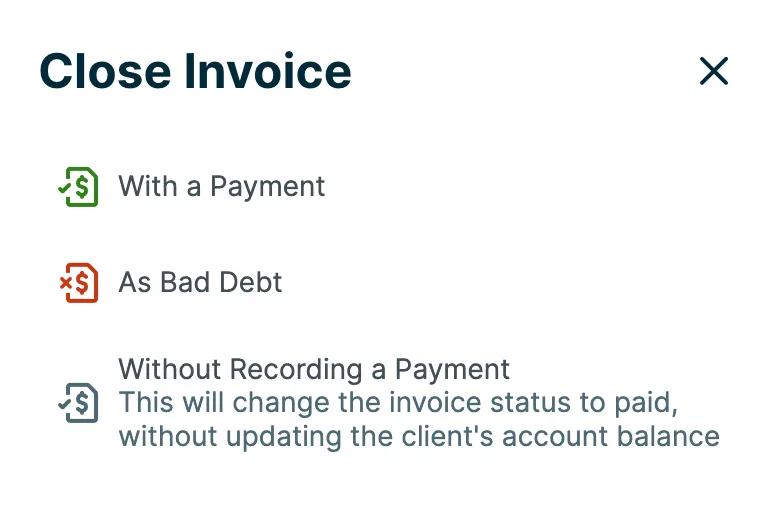
- Close Invoice: Closing the invoice will give you three options:
- With a Payment: This is the same as clicking Collect Payment. You will be prompted to enter the payment details and the invoice balance will be updated.
- Bad Debt: This will change the invoice status to Bad Debt, deeming it uncollectible and removing it from Awaiting Payment and Past Due lists. If an invoice has been partially paid, marking it as Bad Debt will only affect the remaining balance owed.
- Without a Payment: This will change the invoice status to Paid, but won’t record a payment against it so the invoice balance will still look like it’s owing.
- Note: This option works best if you are keeping track of client balances and payments outside of Jobber, but otherwise clicking Collect Payment is a better option since it updates the invoice status and the invoice balance.
- Delete: Delete this invoice.
- Void invoice: This is an option on unpaid invoices to cancel the invoice without deleting in. Learn more about void invoices.
Void an invoice
Voiding an invoice cancels the invoice without deleting it. The voided record stays in Jobber for your audit history, but it is immutable — it cannot be edited, sent, or paid. Use voiding when an invoice was created in error, is a duplicate, or the client has requested cancellation.
You can only void unpaid invoices. Voiding is not available for progress invoicing schedule invoices or invoices tied to Wisetack consumer financing. If your account is in a franchise network, voiding may not be available until your franchise reaches full feature rollout.
To void an invoice:
- Open the invoice you want to void.
- Select More Actions, then select Void Invoice.
- Select a reason for voiding:
- Duplicate: this invoice was created more than once
- Created in error: this invoice should not have been created
- Client request: the client has asked to cancel this invoice
- Select Void Invoice to confirm.
Once voided, the invoice status changes to Voided. If a deposit was attached to the invoice, Jobber automatically releases it back to the client’s account balance. Your client receives an email and SMS notification confirming the cancellation.
To find voided invoices, filter the invoices list by the Voided status.
When to void an invoice vs. mark it as bad debt
Jobber gives you two ways to close out an invoice that won’t be paid: voiding and bad debt.
Void the invoice when the invoice itself was a mistake — for example, it was a duplicate, created in error, or the client cancelled before work started. Voiding preserves the record for your audit history but closes the invoice permanently, releases any attached deposit, and notifies your client.
Use bad debt when the work was completed and the invoice was valid, but the client is not going to pay. Marking an invoice as bad debt writes off the remaining balance for accounting purposes and removes the invoice from the client’s billing history. The invoice stays in Jobber as a record that the work happened and payment was owed.
If you’re unsure which to use, ask: did the work happen and was the invoice correct? If yes, use bad debt. If no, void the invoice.
View your invoice’s history
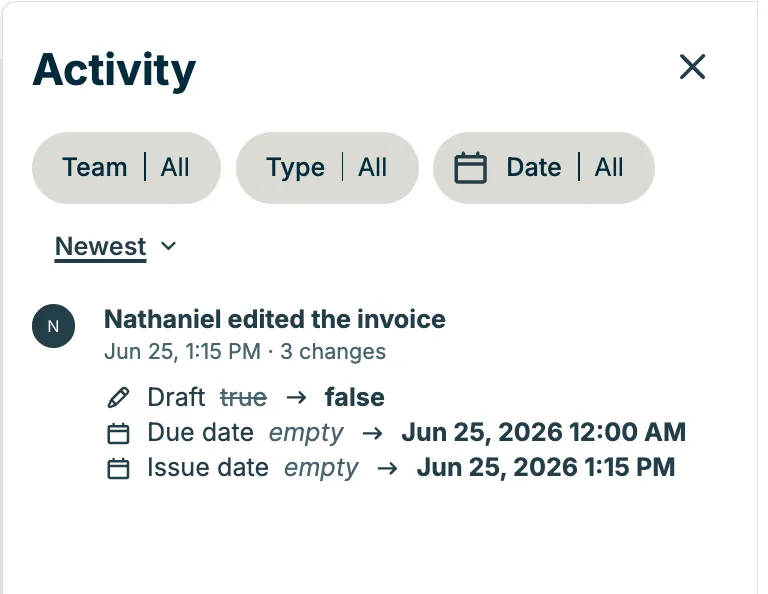
Invoices include a history feed that tracks edits and related activity, such as deposits and payments, so you always know what changed and when.
To view an invoice’s history:
- Open the invoice.
- Select the clock icon next to More, at the top of the invoice.
The Activity panel opens on the right side of the screen, showing a running list of changes made to the invoice, sorted by newest first. Filter the feed by Team, Type, or Date to narrow down what you see. Each entry shows who made the change, when it happened, and exactly what changed. For example, editing an invoice’s due date, issue date, or draft status shows the before and after value for each field. Related activity, such as deposits and payments, also appears in the feed.
Import historical work into Jobber
If you’re new to Jobber, your past jobs and invoices can be brought into Jobber using our import feature where work items can be imported using a CSV spreadsheet.
By importing past jobs and invoices, you can maintain a record of completed work, reference historical details, and keep your workflow organized–all within Jobber.
Learn more about the job import
Learn more about the invoice import
Invoice reminders
Invoice reminders are what trigger jobs to go into “requires invoicing” status. They are generated based on your settings when you create a job on how frequently you would like to invoice. You can set up jobs to remind you to invoice at the correct times using invoice reminders.
There are different invoicing options for one-off jobs and recurring jobs. One-off jobs will prompt you to invoice once the job is closed, whereas recurring jobs can be set up to remind you to invoice at different points throughout the duration of the job such as after each visit or at the end of the month.
How to remove a job from “Requires Invoicing” status
If you have closed a job but it is in “requires invoicing” status, there will be an outstanding invoice reminder for this job which is prompting you to invoice. You will need to either delete this invoice reminder or create an invoice in order to get the job out of this status. Learn more about Invoice Reminders.
To remove a job from “requires invoicing” status:
- Navigate to the job.
- Scroll down to the Billing section.
- Open the Reminders tab from the billing section.
- Click the overdue invoice reminder.
- Choose one of the following:
- To create an invoice, click Create Invoice.
- If you don’t need to invoice, click More Actions then select Delete to remove the reminder.
Once the reminder is cleared or an invoice is created, the job will no longer show Requires Invoicing and will move to Archived status if no invoicing is needed.
Close an invoice that has already been paid
If there is already a recorded payment on an invoice and the balance owed is $0, but it shows as “Awaiting Payment” or “Past due”, it’s likely that the invoice was reopened at some point. This may have been done by accident or follow an intentional adjustment. If you are confident that the recorded payment is accurate, you can follow these steps:
- Click on More actions button.
- Select Close invoice from the menu.
- Select Without recording a payment from the pop-up window.
This closes the invoice and changes the label to “Paid”. It also maintains the original recorded payment, as you’re closing the invoice without an additional payment.
Progress invoicing
For larger jobs or projects completed over time, you may not want to invoice for the full amount all at once. Progress invoicing lets you break a job into multiple invoices so you can get paid as work is completed.
With progress invoicing, you can set up a payment schedule either as a deposit or a series of payments tied to milestones or project stages. This helps set clear expectations with your client and supports steady cash flow throughout the job.
If your work involves multi-stage projects or longer timelines, progress invoicing can be a helpful way to invoice incrementally instead of waiting until the end.
Learn more about progress invoicing
Automatic payments
With automatic payments, clients who have a card stored on their profile through Jobber Payments are able to be automatically charged at the billing frequency that is set up upon job creation. Invoices will be automatically created and charged using Jobber Payments. Learn more.
Move a deposit to a different invoice
If you need to apply a deposit to a different invoice for the same client, you can do this yourself in Jobber.
To move a deposit to a different invoice:
- Open the original invoice and select the pencil icon in the Product/Service section to enter edit mode.
- In the Deposits row of the payment summary, delete the deposit by selecting the trashcan icon — this returns it to the client’s account balance, where it will be available to apply to another invoice.
- Select Save.
- Open the invoice you want to apply the deposit to and select the pencil icon in the Product/Service section.
- In the Deposits row, select Add Deposit.
- Choose the available deposit from the list and apply it.
- Select Save.
Note: Deposits can only be moved between invoices for the same client. Deposits cannot be moved between quotes, as a deposit on a quote represents a financial commitment to that specific agreement. If an invoice with an attached deposit is voided, the deposit is automatically released to the client’s account balance.
Invoice follow-ups
Invoice follow-ups are available on select plans. Invoice follow-ups can be set up by admin users by navigating to the Gear Icon, then select Settings, then Automation. Learn more about automations.
Invoice follow-ups automatically remind clients their invoice is past due. Pairing this reminder with Jobber Payments, gives your client an easy way to pay.